




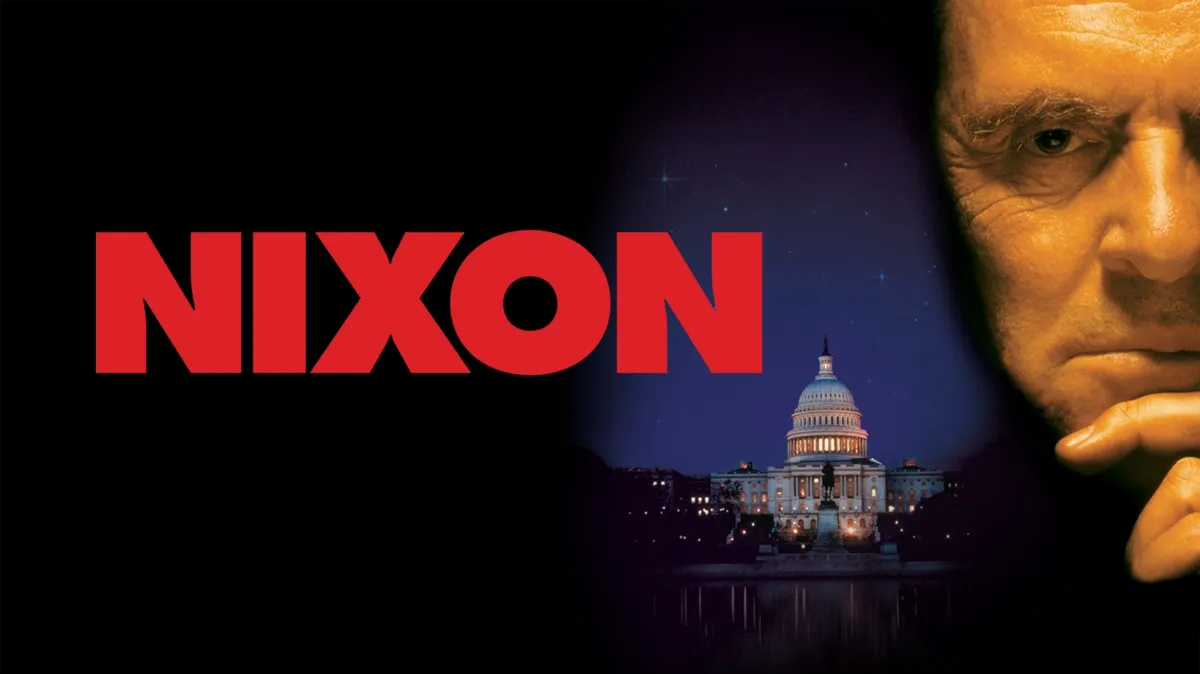
Nixon (released in theaters on Dec. 22, 1995) is a dense, ambitious political drama that turns the life of America’s 37th president into something approaching Shakespearean tragedy. Rather than a simple biopic or Watergate procedural, writer-director Oliver Stone digs into Richard Nixon’s psyche—his resentments, insecurities, and hunger for power—and shows how a brilliant political mind collapses under the weight of its own demons.
The film frames Nixon’s story from the vantage point of a beleaguered White House, using the infamous secret tapes as a portal into memories that stretch from his harsh Quaker upbringing to his rise and fall in national politics.
Anthony Hopkins plays Nixon as a man perpetually at war with himself: socially awkward yet fiercely ambitious, craving love from a public he distrusts.
Flashbacks trace his early campaigns, losses that scarred him, and his eventual ascent to the presidency, where Vietnam, protest movements, and a deep fear of enemies both real and imagined shape his every move.
Watergate becomes less a single “gotcha” scandal than the inevitable outcome of a worldview built on siege mentality and control.
Stone surrounds Nixon with a vivid ensemble of advisors, rivals, and family.
Joan Allen’s Pat Nixon is quietly devastating, embodying a woman who understands her husband’s flaws yet remains bound to him by loyalty and shared history.
James Woods, J.T. Walsh, and others evoke a cabinet and staff caught between service and self-preservation, while Sam Waterston, Powers Boothe, Paul Sorvino, Bob Hoskins, Ed Harris, and David Hyde-Pierce appear as figures representing institutions—intelligence, media, party machinery—that both empower and entrap Nixon.
The film’s structure jumps in time, creating an impressionistic tapestry rather than a strictly linear biography, underscoring how the ghosts of Nixon’s past never stop haunting his present.
Hopkins doesn’t imitate so much as interpret, using physicality, voice, and stillness to capture a man who can read a room politically yet fails to read his own moral limits. Allen matches him beat for beat, and the supporting cast adds flavor without turning into mere caricature.
Stone’s direction blends archival imagery, stylized camerawork, and moody lighting to create an atmosphere of looming dread.
This was Stone’s second of three films about the presidents of the United States, after JFK starring Kevin Costner, which focused on the assassination of John F. Kennedy and its aftermath, and W., which starred Josh Brolin as George W. Bush.
E.G. Marshall, Marley Shelton, David Paymer, Kevin Dunn, Saul Rubinek, James Karen, Mary Steenburgen, Tony Goldwyn, John Diehl, Madeline Kahn, Edward Herrmann, Dan Hedaya, Bridgette Wilson-Sampras, Tony Lo Bianco, Michael Chiklis, James Pickens Jr. and John C. McGinley round out the all-star cast.

Anthony Hopkins and James Woods in Nixon (Photo/Hollywood Pictures)
Reception for Nixon
Nixon grossed $2.2 million on its opening weekend, finishing 13th at the box office in limited release of 514 theaters.
The film would gross $13.7 million in its theatrical run.
Legacy
Nixon was a box office disappointment, grossing $13.7 million on its $44 million budget and the film has a 76% rating on Rotten Tomatoes.