











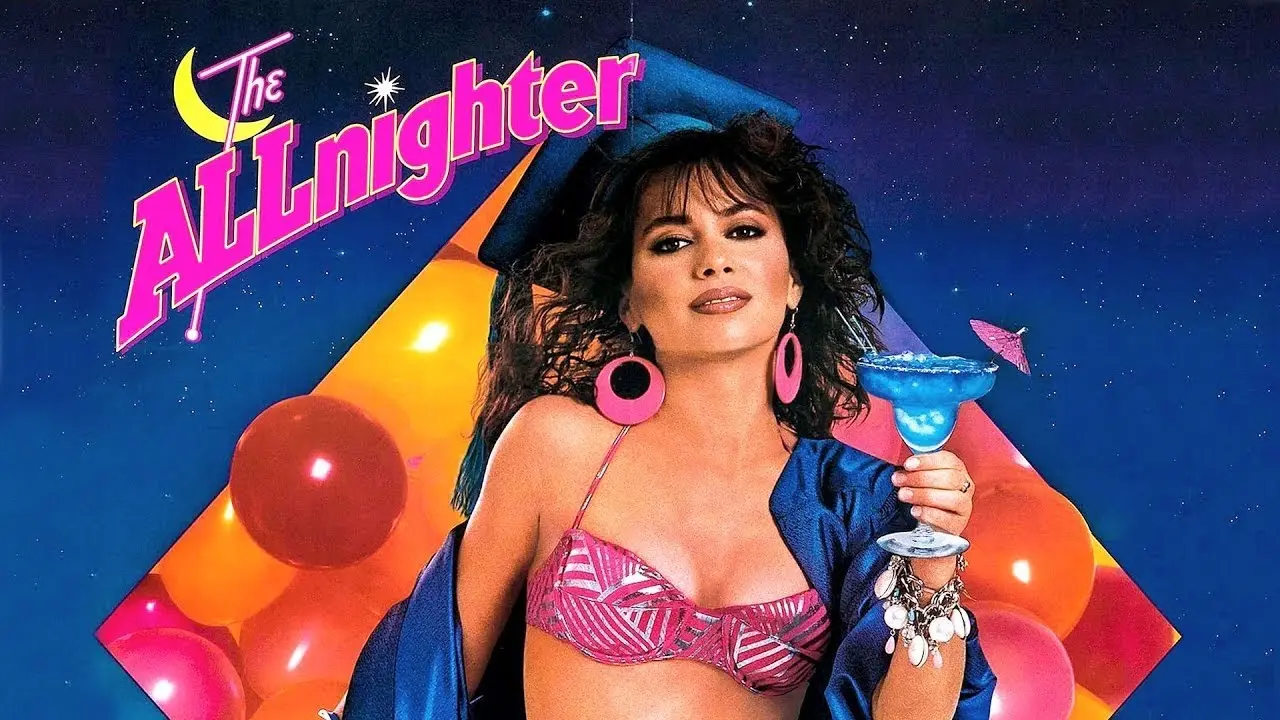
The Allnighter (released in theaters on May 1, 1987) follows college roommates Molly, Val, and Gina as they navigate the final frantic twenty-four hours before their graduation from a sun-drenched Southern California university.
Molly (Susanna Hoffs) is determined to finally make a move on her long-time crush, a popular surfer, while her friends deal with their own impending adulthood and romantic entanglements.
The plot unfolds as a quintessential “one crazy night” narrative, centered around a massive end-of-the-year beach bash at a local hotel.
As the trio moves from the classroom to the surf, they encounter a series of comedic mishaps, late-night heart-to-hearts, and the bittersweet realization that their carefree student days are coming to an end.
It is a lighthearted, neon-soaked journey through the anxieties of the Class of ’87, capturing that specific moment when the safety of the campus meets the uncertainty of the real world.
Hoffs, of The Bangles fame, brings her effortless pop-star charisma to the role of Molly, serving as the film’s charming emotional center.
She is joined by a vibrant Dedee Pfeiffer as Val and a wonderfully quirky Joan Cusack as Gina, the latter of whom provides the film’s most inspired comedic moments.
The cast is surprisingly diverse in talent, featuring the legendary Pam Grier as a tough-but-fair Sergeant and Michael Ontkean as a professor who adds a touch of adult complexity to the youthful proceedings.
John Terlesky rounds out the ensemble as the object of Molly’s affection, embodying the quintessential eighties heartthrob.

Susanna Hoffs in The Allnighter (Photo/Universal Pictures)
Reception for The Allnighter
The Allnighter grossed $1.4 million on its opening weekend, finishing ninth at the box office.
The film would gross $2.7 million in its theatrical run.
Legacy
The Allnighter is remembered as a colorful time capsule of late-eighties youth culture, specifically the “surf and sand” aesthetic that dominated the era’s media.
While it was produced during the height of the teen comedy boom, it remains a cult favorite primarily for being the rare starring vehicle for Hoffs at the peak of her musical fame.
The movie is celebrated by fans of the decade for its soundtrack and its unapologetically nostalgic fashion, representing the bridge between the brat-pack era and the more cynical nineties.
Its legacy also includes its place in the history of female-led comedies, focusing on the bond of friendship between the three protagonists rather than purely on the male gaze.