





Multiplicity (released in theaters on July 17, 1996) delivers a brilliantly funny, high-concept premise that uses science-fiction tropes to explore the overwhelming pressures of balancing modern work, family, and personal life. Directed with his signature witty pacing by comedy legend Harold Ramis, the plot centers on Doug Kinney (Michael Keaton), a stressed-out, perpetually exhausted construction worker living in Los Angeles.
Doug finds himself stretched thin between the endless demands of his construction boss, Vic (Brian Doyle-Murray), and his loving family, including his wife Laura (Andie MacDowell) and their two children.
During a remodeling job at a high-tech scientific institute, Doug vents his anxieties to an eccentric geneticist, Dr. Leeds (Harris Yulin), who offers a radical, top-secret solution to his time management crisis: cloning him so he can literally be in two places at once.
The narrative shifts into a chaotic farce as Doug accepts the offer, creating “Two,” an ultra-masculine, work-oriented clone who takes over his demanding construction job while the original Doug stays home to bond with his family.
However, when Doug still feels overwhelmed, he creates “Three,” a sensitive, domestic clone who handles the cooking, cleaning, and emotional needs of the household.
The situation spirals into pure absurdity when the two clones secretly take it upon themselves to create “Four,” a clone of a clone who turns out to be a child-minded, easily distracted simpleton.
As Doug tries to hide the growing army of lookalikes from his suspicious wife, he must also manage his sleazy coworker, Del Bert (Richard Masur), and an eccentric inspector (Eugene Levy).
The narrative builds to a frantic, high-stakes climax as the clones get mixed up in each other’s schedules, forcing the original Doug to realize that taking shortcuts in life only dilutes the meaningful moments he was trying to save.

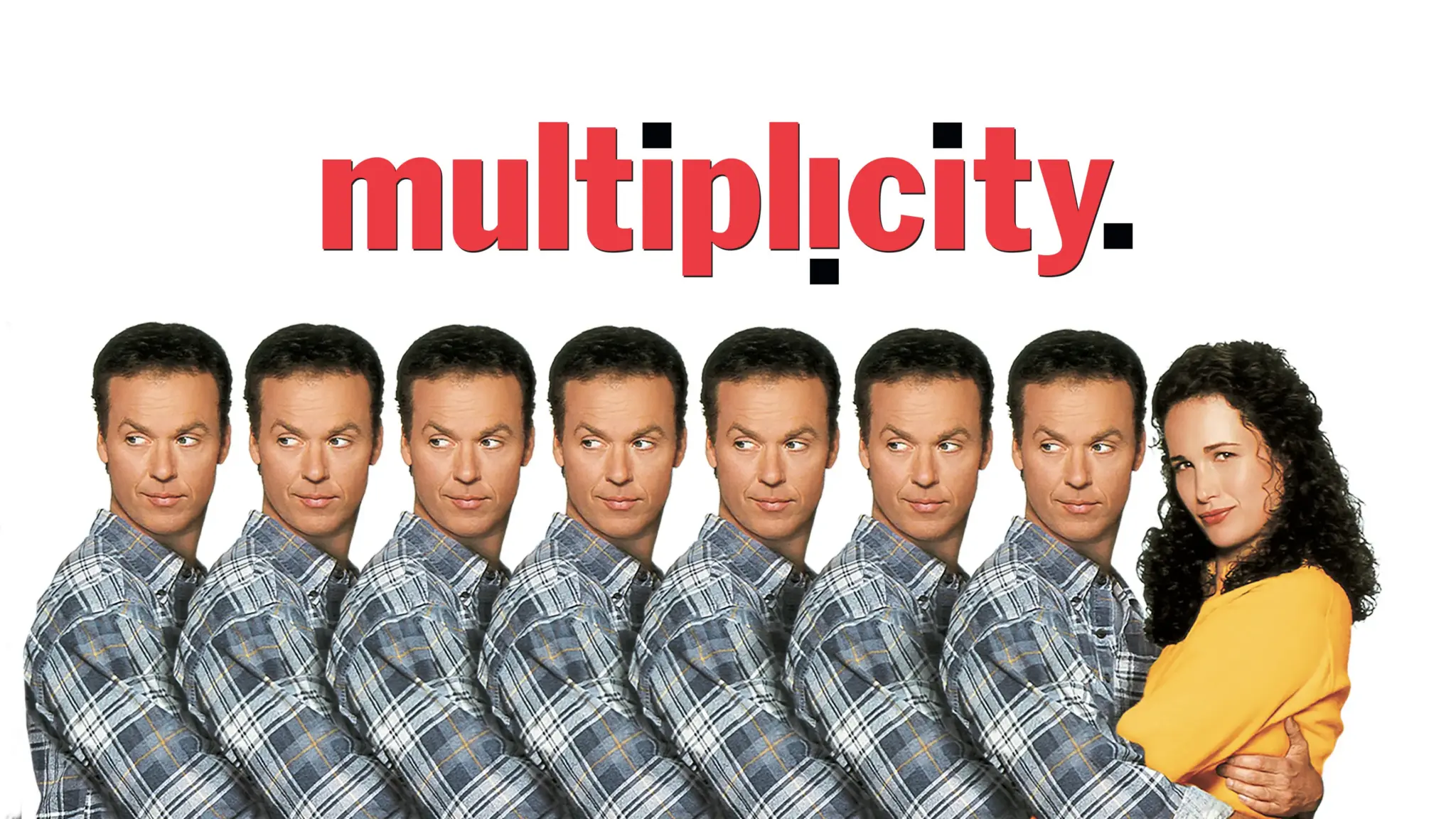
Michael Keaton and Andie MacDowell in Mulitiplicity (Photo/Columbia Pictures)
Reception for Multiplicity
Multiplicity grossed $5.1 million on its opening weekend, finishing seventh at the box office. The top grossing film was Independence Day, which earned $21.3 million on its third weekend.
The film would gross $21.1 million in its theatrical run.
Roger Ebert gave Multiplicity two and a half out of four stars in his review.
Legacy
Multiplicity‘s legacy is highly secure, celebrated by cinephiles as a true masterclass in technical filmmaking and visual effects execution for its era.
Long before digital compositing became standard, Ramis and his team pushed the limits of motion-control camera technology to allow Keaton to seamlessly interact, share props, and talk over himself as four completely distinct individuals on screen at once.
The picture stands out as a phenomenal showcase for Keaton’s exceptional comedic range, as he effortlessly crafts four entirely unique personalities, voices, and physical traits, proving his elite leading-man capabilities.
Multiplicity is remembered as a deeply underrated, prophetic commentary on the modern obsession with productivity and multitasking, remembered as a smart, heartwarming, and endlessly creative gem of 1990s studio comedy cinema.