







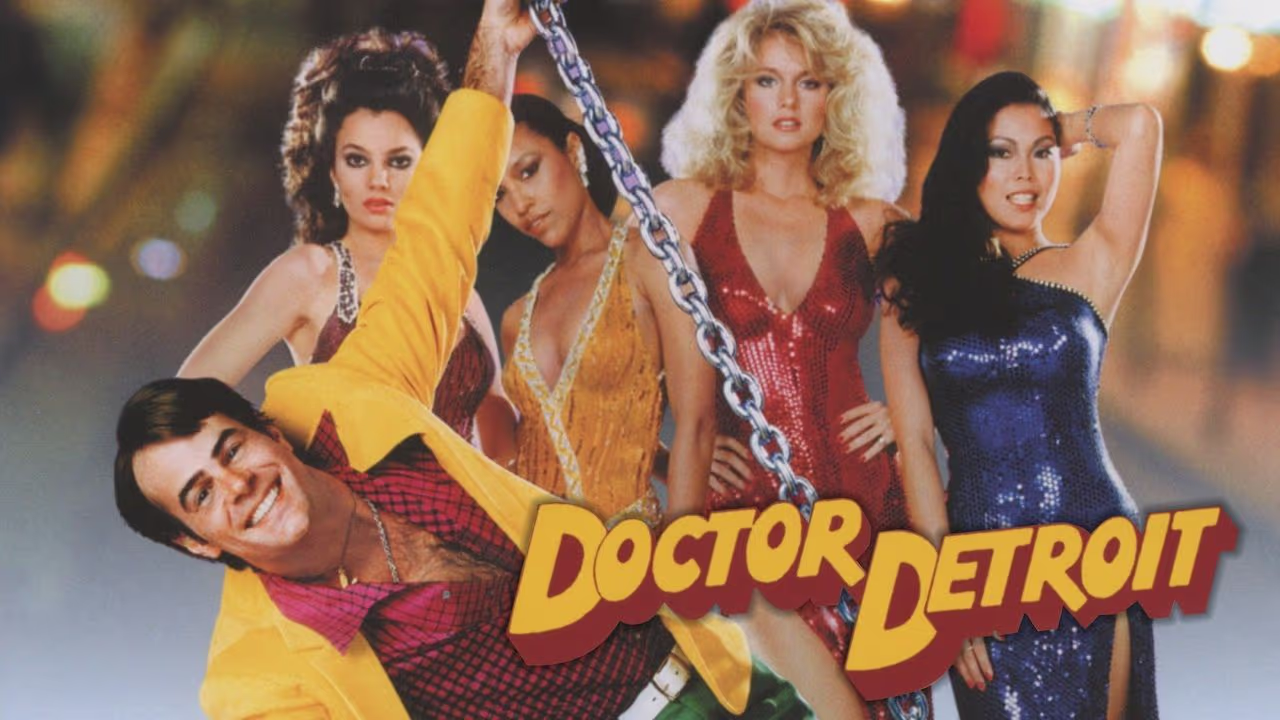
Doctor Detroit (released in theaters on May 6, 1983) stars Dan Aykroyd as Clifford Skridlow, a mild-mannered, stuffy professor of comparative literature at a small Chicago college. Clifford’s life is a predictable routine of academic lectures and chivalrous manners until he crosses paths with Smooth Walker (Howard Hesseman), a flamboyant pimp who owes a significant debt to a ruthless crime lord known as “Mom.”
In a desperate bid to escape Mom’s wrath, Smooth invents a mythical, terrifying boss named “Doctor Detroit” and cons the naive Clifford into assuming the identity.
Suddenly, the academic who once worried about syllabi finds himself protecting four women – played by Lynn Whitfield, Fran Drescher, Donna Dixon, and Lydia Lei – from the Chicago underworld.
Under the guidance of his street-smart chauffeur, Diavolo (T.K. Carter), Clifford fully embraces his alter ego.
He transforms into a junk-wearing, fast-talking vigilante with a metallic hand and a wild wardrobe.
As Doctor Detroit, Clifford navigates a series of increasingly absurd confrontations, including a high-stakes showdown at a junkyard and a lavish party where his two worlds inevitably collide.
The plot is a whirlwind of slapstick humor and 1980s excess, featuring a memorable soundtrack and cameo appearances that capture the vibrant, neon-soaked energy of the era.
Director Michael Pressman leans into the absurdity, allowing Aykroyd to deliver one of his most manic and physically expressive performances.
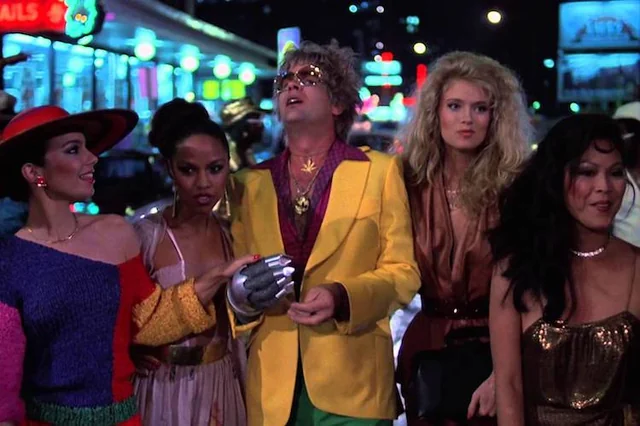
Dan Aykroyd in Doctor Detroit (Photo/Universal Pictures)
Reception for Doctor Detroit
Doctor Detroit grossed $3.3 million on its opening weekend, finishing second at the box office, trailing Flashdance, which earned $3.4 million on its fourth weekend.
The film would gross $10.4 million in its theatrical run.
Roger Ebert gave Doctor Detroit three out of four stars in his review.
Legacy
Doctor Detroit’s legacy is defined by its status as a peak example of the “high-concept” comedy that dominated the early 1980s.
While it didn’t achieve the same blockbuster heights as Ghostbusters, it remains a cherished cult classic for its sheer weirdness and Aykroyd’s total commitment to the dual roles of the bumbling professor and the flamboyant Doctor.
Beyond the screen, the movie serves as a testament to a time when major studios were willing to bankroll bizarre, character-driven comedies that defied traditional logic in favor of pure, unadulterated fun.
Its influence can be seen in later “transformation” comedies where a square protagonist discovers their inner wild side through a ridiculous masquerade.
Doctor Detroit stands as a colorful, energetic time capsule of SNL-era talent at its most experimental, proving that sometimes the best way to find yourself is to pretend to be someone completely insane.