









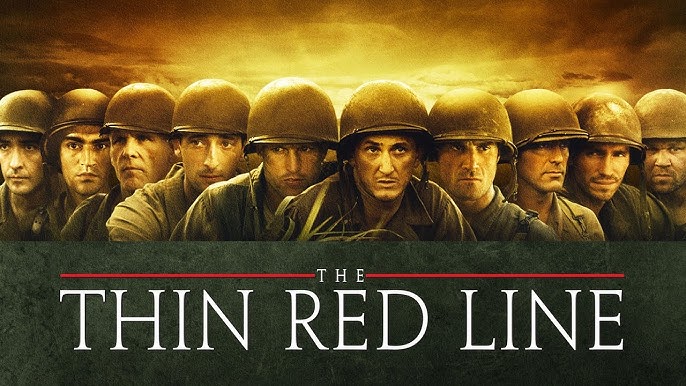
The Thin Red Line (released on Dec. 25, 1998), which marked director Terrence Malick‘s return to filmmaking after a twenty-year hiatus, is an expansive and philosophical reimagining of James Jones’s semi-autobiographical novel.
Eschewing the traditional “hero’s journey” found in most combat cinema, Malick crafted a sprawling, transcendental tone poem that juxtaposes the terrifying violence of the Guadalcanal Campaign with the indifferent beauty of the natural world. It remains one of the most visually stunning and intellectually demanding war films ever produced.
The film primarily follows Private Witt (Jim Caviezel), a soulful deserter living in harmony with Melanesian natives before being recaptured by the U.S. Navy.
Reassigned to “C-for-Charlie” Company, Witt becomes a quiet observer of the internal and external conflicts of his fellow soldiers as they prepare to seize a strategic Japanese-held airfield.
The battalion is led by Lieutenant Colonel Tall (Nick Nolte), a career-driven officer whose desperation for a victory leads him to push his men toward suicidal frontal assaults.
As the company moves through the tall kunai grass toward the fortified Hill 210, the narrative shifts through a series of interior monologues from various soldiers.
First Sergeant Welsh (Sean Penn) struggles with his cynical worldview while clashing with Witt’s idealism. Captain Staros (Elias Koteas) emerges as the moral heart of the unit, eventually refusing Tall’s orders to protect his men from a massacre.
Throughout the bloody siege, we witness the fates of soldiers played by a massive ensemble, including Ben Chaplin, Adrien Brody, John Cusack, Woody Harrelson, Jared Leto, and John C. Reilly.
Brief but pivotal appearances by George Clooney, John Travolta, and John Savage emphasize the scale of the conflict.
The film follows the company through the horrors of the ridge and into the psychological aftermath, as the men, including characters played by Don Harvey, Nick Stahl, and Thomas Jane, try to find meaning in a world where “nature is cruel” and man is at war with himself.
Performances by Bill Pullman, Lukas Haas, and Mickey Rourke did not make the final 171 minute cut.

George Clooney in The Thin Red Line (Photo/20th Century Fox)
Reception for The Thin Red Line
The Thin Red Line grossed $11.4 million on its opening weekend of wide release, finishing third at the box office.
The film would gross $98.1 million worldwide.
Roger Ebert gave The Thin Red Line three out of four stars in his review.
Legacy
The legacy of The Thin Red Line is defined by its radical departure from conventional narrative structures, prioritizing mood and existential inquiry over plot.
It is famously remembered for Malick’s ruthless editing process, which drastically reduced the roles of major stars to focus on the collective experience of the “thin red line” between the sane and the mad.
While it was released the same year as the more visceral Saving Private Ryan, The Thin Red Line has aged into a singular work of art that appeals to viewers seeking a more contemplative, spiritual perspective on human conflict.