









The Jesse Owens Story (premiered on July 9, 1984) is a sweeping and deeply reverent biographical drama that chronicles the life of one of the greatest athletes in human history. Originally aired as a two-part television miniseries, the film treats its subject with a dignity that matches the gravity of his achievements.
It is a production that understands that the story of Jesse Owens is not just about physical speed, but about the endurance of the human spirit in the face of institutional racism at home and the rise of fascism abroad.
The film remains a definitive portrayal of the 1936 Berlin Olympics and the man who single-handedly dismantled the myth of Aryan supremacy on the world stage as told in flashbacks from the perspective of reporter Lew Gilbert (Georg Stanford Brown).
The story follows Jesse Owens (Dorian Harewood) from his humble beginnings to his time as a track star at Ohio State University.
Under the guidance of his dedicated coach, Charles Riley (George Kennedy), Jesse breaks world records with ease, yet he remains subjected to the segregation and prejudice of 1930s America.
The narrative tension escalates as the 1936 Olympics approach, with prominent figures debating whether the United States should boycott the games held in Nazi Germany.
Despite the political pressure, Jesse travels to Berlin, where he is supported by teammates and mentors.
The film meticulously recreates his four gold-medal wins, capturing the silent defiance of a Black American dominating in the presence of Adolf Hitler.
However, the story does not end at the finish line; it follows Jesse back to the United States, where he faces a different kind of struggle. Despite his global fame, he is met with financial hardship and a lack of professional opportunities, aided by friends and associates.
The narrative serves as a poignant reminder that while Jesse won the race, the battle for true equality was far from over.
LeVar Burton, Ronny Cox, Barry Corbin, Ben Vereen, Norman Fell, James B. Sikking and Vic Taybeck round out the cast.
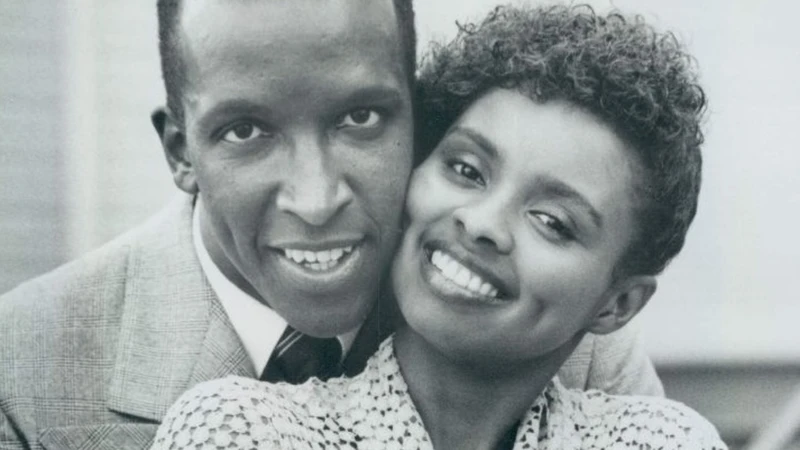
Dorian Harewood and Debbi Morgan in The Jesse Owens Story (Photo/Paramount Television)
Legacy of The Jesse Owens Story
The Jesse Owens Story‘s legacy lies in its commitment to telling a complete version of Owens’ life, moving beyond the headlines to explore his personal sacrifices and the indignities he suffered after returning home.
Harewood delivers a career-defining performance, capturing the grace, humility, and quiet strength that defined Owens.
The film’s legacy also persists as an educational tool, often cited for its accurate depiction of the racial climate of the 1930s and its star-studded ensemble of character actors who brought the era to life.
The Jesse Owens Story remains a cornerstone of sports cinema, celebrated for its emotional depth and its celebration of a man who ran toward history when the world was standing still and stands as a powerful tribute to a hero whose footprints are still felt on and off the track.