



In Heaven Help Us (released in theaters on Feb. 8, 1985), set in 1965 Brooklyn, Michael Dunn (Andrew McCarthy) is the new kid at St. Basil’s, a strict Catholic boys’ school where the discipline is as heavy as the atmosphere.
Michael quickly discovers that life under the watchful, often terrifying eyes of the monks – led by the formidable Brother Thadeus (Donald Sutherland) and the eccentric, obsessive Brother Virgil (Wallace Shawn) – is a constant battle of wills.
To survive, he falls in with a motley crew of misfits, including the tough-talking, rebellious Rooney (Kevin Dillon), the intellectually gifted but socially awkward Caesar (Malcolm Danare), and the hormone-driven Corbett (Patrick Dempsey) and Williams (Stephen Geoffreys).
The plot balances the raucous, bathroom-humor-filled pranks of the boys with Michael’s tentative, heartfelt romance with Danni (Mary Stuart Masterson), a girl who runs the local soda shop and carries the burden of caring for her mentally ill father.
As the boys navigate the absurdities of their repressive education – including a memorable “dating seminar” and the constant threat of corporal punishment from the humorless Brother Spark (Jay Patterson) – they find a rare ally in the sympathetic and progressive Brother Timothy (John Heard).
The narrative builds to a defiant, chaotic showdown during an official school inspection, where the students’ collective frustration with the archaic rules explodes in a grand gesture of teenage solidarity and comedic liberation.
Dana Barron, Philip Bosco and Yeardley Smith round out the cast.
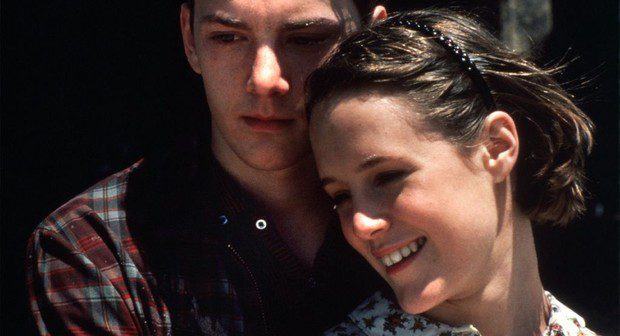
Heaven Help Us (Photo/Tri-Star Pictures)
Reception for Heaven Help Us
Heaven Help Us grossed $2.2 million on its opening weekend, finishing seventh at the box office. Beverly Hills Cop topped the box office for its tenth consecutive week, earning $6 million.
The film would gross $6.1 million in its theatrical run.
Roger Ebert gave Heaven Help Us two and a half out of four stars in his review.
Legacy
The legacy of Heaven Help Us lies in its perfect capture of the mid-60s zeitgeist, blending the transition from the buttoned-down fifties to the radicalism of the sixties with a uniquely Catholic sense of guilt and humor.
Unlike many of its more cartoonish contemporaries, the film is remembered for its grounded, authentic performances, serving as an early showcase for a “Brat Pack” era ensemble that would dominate the decade.
Dillon’s turn as the swaggering yet vulnerable Rooney is often cited as a standout, alongside the poignant chemistry between McCarthy and Masterson.
It remains a beloved cult classic for its refusal to shy away from the darker side of institutional discipline while maintaining a joyful, rebellious spirit.