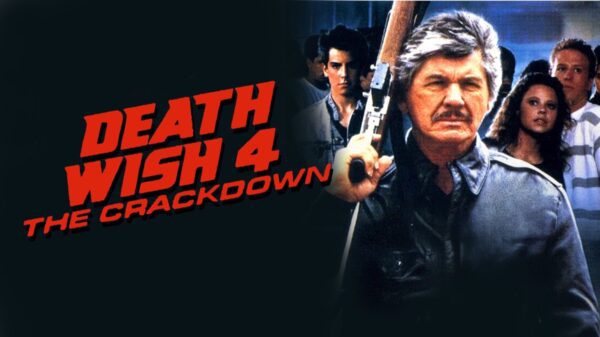


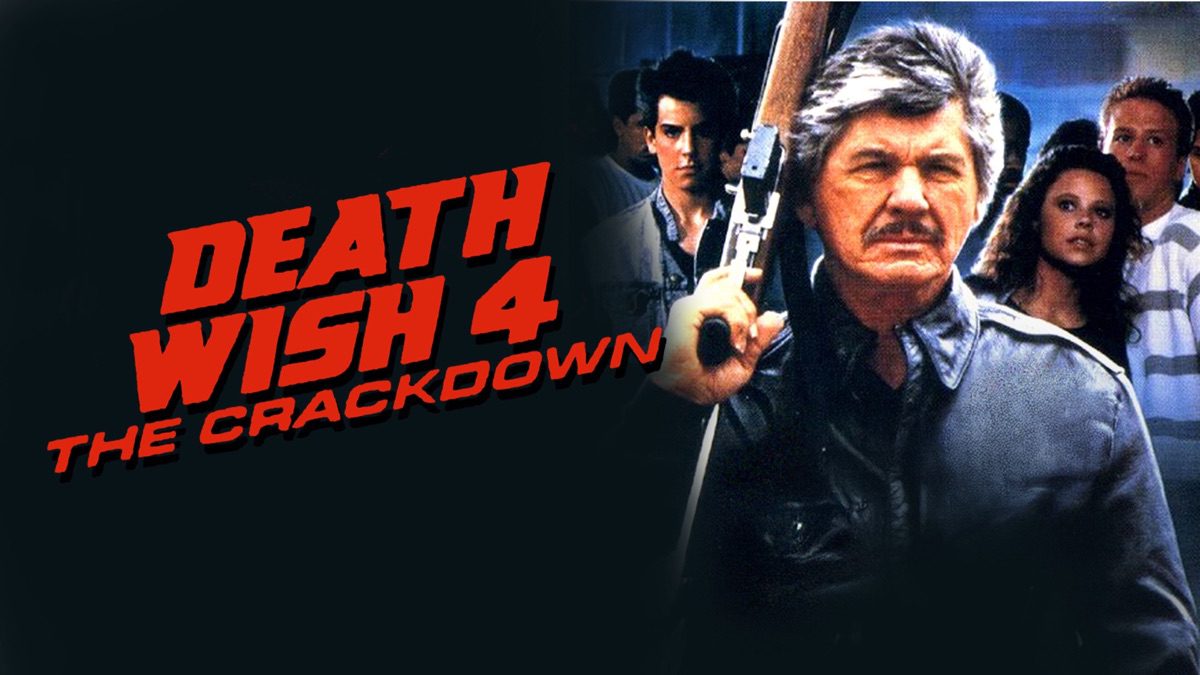
Death Wish 4: The Crackdown (1987), directed by J. Lee Thompson and produced by Cannon Films, marks a significant shift in the iconic vigilante franchise. While the previous film Death Wish 3 focused on the urban decay of New York City, this fourth installment moves the carnage back to Los Angeles, trading the personal vendettas of the past for a “one-man army” approach to rival drug gangs.
It is a film that embraces the high-octane excess of late-80s action cinema, cementing the persona of the aging but lethal vigilante as a permanent fixture of the genre’s landscape.
The story finds Paul Kersey (Charles Bronson) attempting to live a quiet life as an architect in Los Angeles.
He has found a semblance of peace with his girlfriend, newspaper reporter Karen Sheldon (Kay Lenz), and her daughter, Erica (Dana Barron).
However, tragedy strikes when Erica dies of a drug overdose, leading Kersey to hunt down the pusher responsible.
His actions catch the attention of Nathan White (John P. Ryan), a mysterious, wealthy figure who claims his own daughter was lost to drugs. White offers Kersey an ultimatum: use his “unique skills” to dismantle the two major drug cartels currently tearing the city apart or he will call the police.
Kersey becomes a shadow operative, playing the Ed Zacharias (Perry Lopez) cartel against the Jack Romero faction.
His mission involves high-stakes infiltration and the systematic elimination of key players, including a memorable early-career appearance by Danny Trejo as an underworld henchman.
As the body count rises, Kersey is pursued by detectives Sid Reiner (George Dickerson) and his partner Phil Nozaki (Soon-Tek Oh).
The narrative builds to a brutal showdown at an oil refinery, where Kersey discovers that his benefactor’s motives are far more sinister than they appeared, leading to an explosive finale involving a M203 grenade launcher.
Mark Pellegrino, Mitch Pileggi, Tim Russ and Irwin Keyes round out the cast.
This film was the seventh collaboration between Bronson and Thompson, following 1976’s St. Ives, 1977’s The White Buffalo, 1980’s Caboblanco, 1983’s 10 to Midnight, 1984’s The Evil That Men Do, and 1986’s Murphy’s Law.
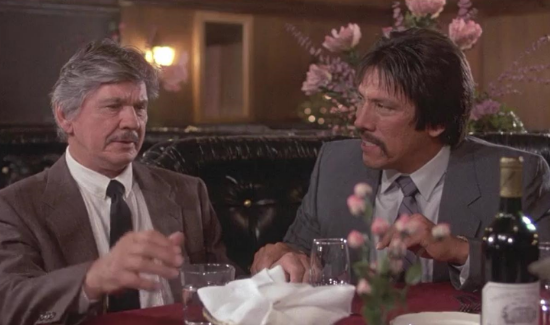
Charles Bronson and Danny Trejo in Death Wish 4: The Crackdown (Photo/Cannon Films)
Reception for Death Wish 4: The Crackdown
Death Wish 4: The Crackdown grossed $2.5 million on its opening weekend, finishing sixth at the box office. The top film was Fatal Attraction, which earned $7.1 million on its eight weekend.
The film would gross $6.9 million in its theatrical run.
Legacy
The legacy of Death Wish 4: The Crackdown lies in its transition from a psychological thriller into a pure action spectacle. It represents the peak of the Bronson-Cannon era, where Kersey became less a man and more a mythic force of retribution.
The film is celebrated by genre fans for its creative “traps” and the unwavering, stoic charisma that Bronson maintained well into his sixties.
Furthermore, its legacy persists as a time capsule of the “War on Drugs” era of filmmaking, reflecting the heightened anxieties of the late 1980s.
Death Wish 4: The Crackdown helped to influence a generation of “punisher-style” characters, proving that the vigilante trope had enduring box-office power and it remains a cult favorite for its unapologetic pacing and its role in defining the “aged hero” archetype that dominates action cinema today.