









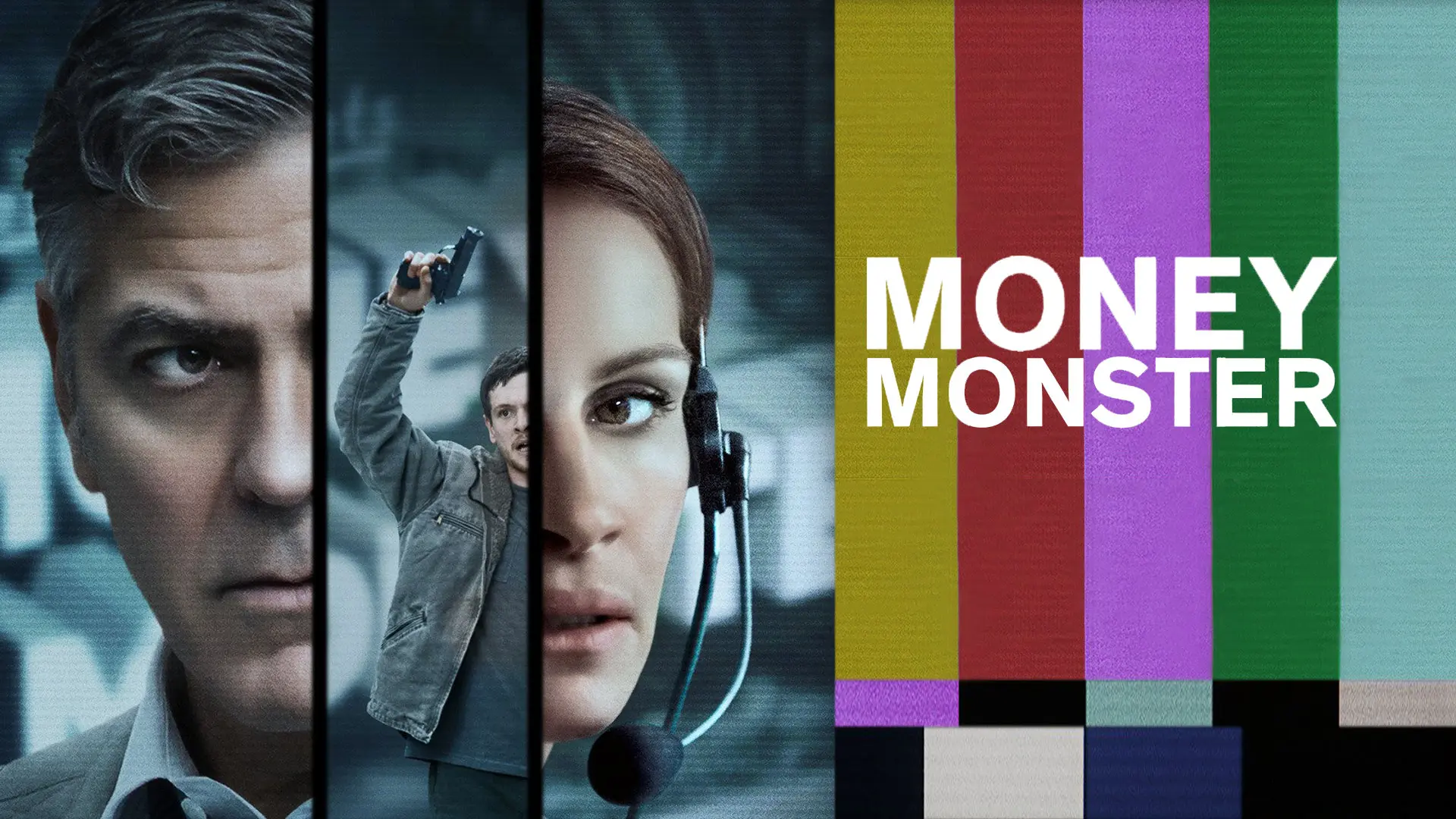
Money Monster (released in theaters on May 13, 2016) stars George Clooney as Lee Gates, a bombastic, arrogant television personality who hosts a popular financial analysis show of the same name. Under the watchful, calm guidance of his long-time director and producer, Patty Fenn (Julia Roberts), Lee turns stock market tips into high-energy entertainment.
The routine broadcast is violently disrupted when Kyle Budwell (Jack O’Connell), a desperate and bankrupt blue-collar worker, sneaks onto the studio set disguised as a delivery man. Kyle pulls a gun, takes Lee hostage on live television, and forces him to don a vest packed with explosives.
Kyle’s grievance stems from a recent “glitch” in the algorithm of a company called Ibis Clear Capital, which caused him to lose his entire life savings of $60,000 based on a direct recommendation from Lee’s show.
The plot evolves into a high-stakes, real-time negotiation broadcast to millions of viewers.
Rather than simply fighting for survival, Patty uses the studio’s communication network to investigate the truth behind Ibis’s sudden $800 million collapse.
As the police, led by Captain Marcus Powell (Giancarlo Esposito), surround the building, Patty and Lee connect with Ibis’s chief communications officer, Diane Lester (Caitríona Balfe).
They discover that the company’s CEO, Walt Cambby (Dominic West), has conveniently gone missing.
The narrative shifts from a standard hostage crisis into a dynamic corporate exposé as Lee begins to sympathize with his captor, realizing that the entire global financial apparatus is rigged against ordinary citizens.
Director Jodie Foster crafts a tight, claustrophobic thriller that thrives on the electric chemistry between Clooney and Roberts.
Clooney masterfully transitions Lee from a superficial showman to a vulnerable, empathetic human being, while Roberts provides the film’s steady, intellectual anchor from the control room.
O’Connell delivers a raw, volatile performance that gives the film its desperate emotional stakes.

Jack O’Connell and George Clooney in Money Monster (Photo/Sony Pictures)
Reception for Money Monster
Money Monster grossed $14.8 million on its opening weekend, finishing third at the box office behind Captain America: Civil War ($72.6 million) and The Jungle Book ($17.1 million).
The film would gross $93.3 million worldwide.
Legacy
The legacy of Money Monster lies in its sharp critique of the post-2008 financial landscape and the gamification of the stock market by mainstream media.
It successfully captured the growing public anger toward corporate malfeasance and the lack of accountability for Wall Street executives.
By blending the ticking-clock mechanics of a hostage thriller with a media satire, it served as a spiritual companion to films like Network and The Big Short.
Ultimately, Money Monster is remembered as a polished, star-driven studio thriller that used its mainstream appeal to deliver an uncomfortable message about economic inequality and the dangerous intersection of news, entertainment, and capitalism.