



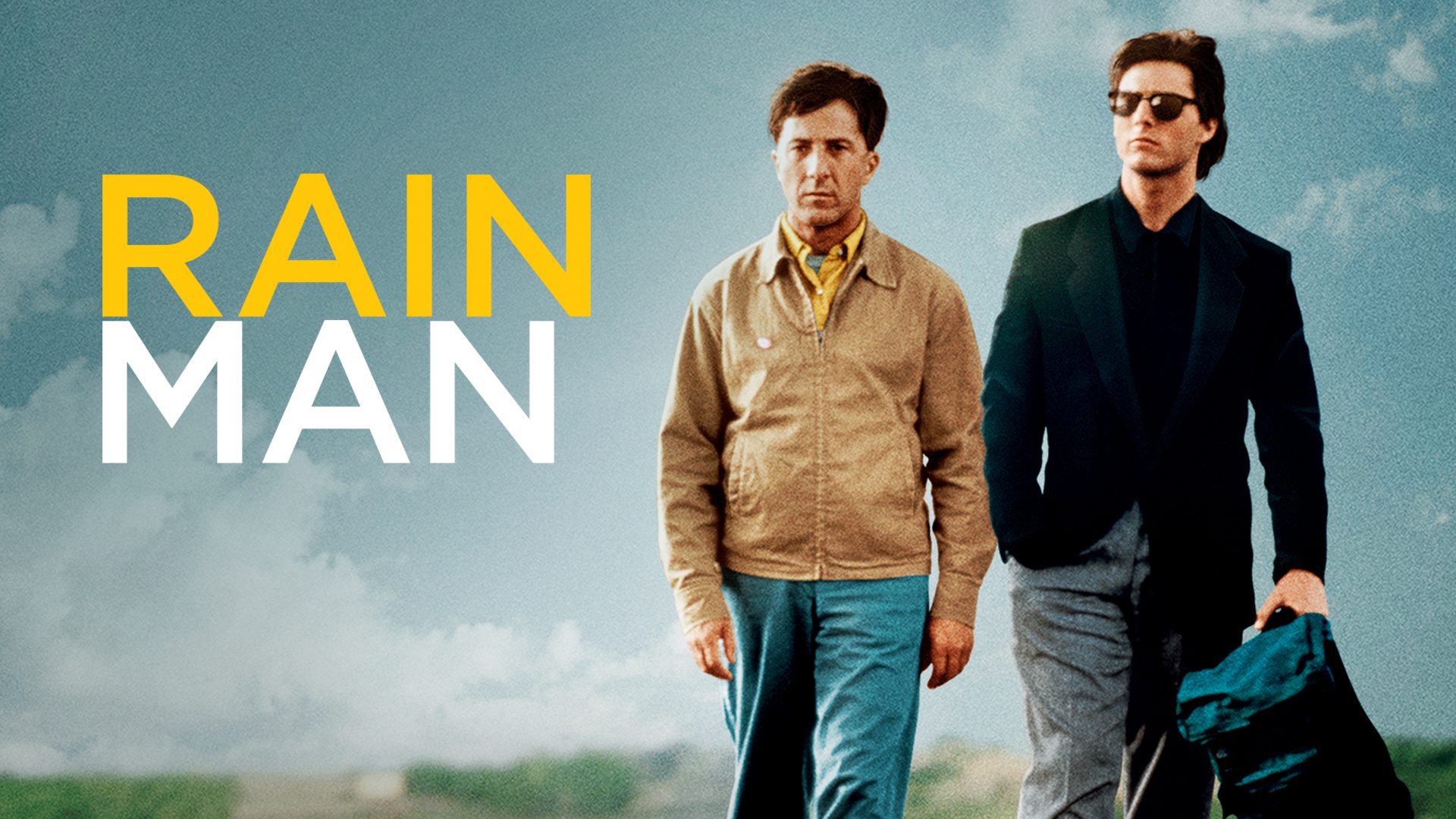
Rain Man (released in theaters on December 16, 1988) tells the story of Charlie Babbitt (Tom Cruise), a self-centered, fast-talking Los Angeles car dealer who is struggling to keep his business afloat. When his estranged father dies, Charlie travels to Cincinnati to settle the estate, only to discover that the $3 million fortune has been left to a nameless beneficiary at a mental institution.
Investigating further, Charlie is shocked to find he has an older brother, Raymond (Dustin Hoffman), an autistic savant of whom he had no memory.
Raymond lives in a world of rigid routines and possesses extraordinary mental abilities, such as lightning-fast calculation and a photographic memory, yet he struggles with social interaction and emotional connection.
Motivated by greed, Charlie “kidnaps” Raymond from the facility, intending to use him as leverage to get his half of the inheritance.
The brothers embark on a cross-country road trip in their father’s 1949 Buick Roadmaster because Raymond refuses to fly.
Along the way, Charlie’s frustration with Raymond’s idiosyncrasies—like his obsession with The Abbott and Costello “Who’s on First?” routine and his strict TV schedule—gradually gives way to genuine affection.
Charlie’s girlfriend, Susanna (Valeria Golino), serves as his moral compass during the journey.
Notable supporting roles include Bonnie Hunt as a waitress who witnesses Raymond’s counting skills and Lucinda Jenney as Iris.
The trip reaches a climax in Las Vegas, where Charlie utilizes Raymond’s ability to count cards to win enough money to save his business, but he ultimately realizes that his relationship with his brother is worth far more than the money.
Directed by Barry Levinson, Rain Man was a cultural phenomenon and a massive critical success, winning four Academy Awards, including Best Picture, Best Director, Best Original Screenplay, and Best Actor for Dustin Hoffman.
Hoffman’s meticulous, deeply researched portrayal of Raymond remains one of the most famous performances in cinema history, though it sparked long-standing debates about the representation of neurodiversity on screen.
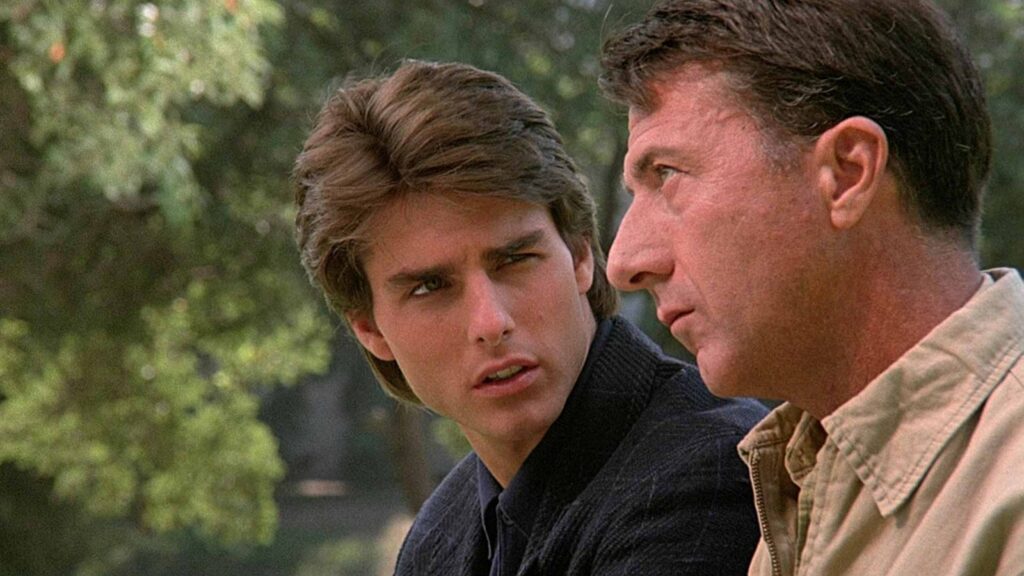
Tom Cruise and Dustin Hoffman in Rain Man (Photo/United Artists)
Reception for Rain Man
Rain Man grossed $7 million on its opening weekend, finishing second at the box office behind Twins, which earned $7.8 million on its second weekend, and ahead of The Naked Gun ($5.6 million) and Scrooged ($4.6 million).
On its third weekend, Rain Man would overtake Twins for the top spot at the box office and remain there for the next five weeks.
The film would remain in the top 10 for its first 23 weeks en route to grossing $412.8 million worldwide.
Roger Ebert gave the film three and a half out of four stars in his review.
Gene Siskel gave Rain Man three and a half out of four stars in his review.
Lasting Legacy
Rain Man’s legacy is twofold. First, it brought unprecedented global awareness to autism, even if it popularized the specific (and rare) “savant” trope. Second, it showcased the incredible range of Tom Cruise; while Hoffman had the more “transformative” role, Cruise’s performance as the morally evolving Charlie is often cited by critics as the emotional anchor that makes the film work.
Rain Man remains a definitive “road movie,” praised for its beautiful cinematography and its refusal to offer a “magical cure” for Raymond’s condition. Instead, it offers a realistic, bittersweet conclusion that emphasizes understanding and the slow, difficult process of building a familial bond.