






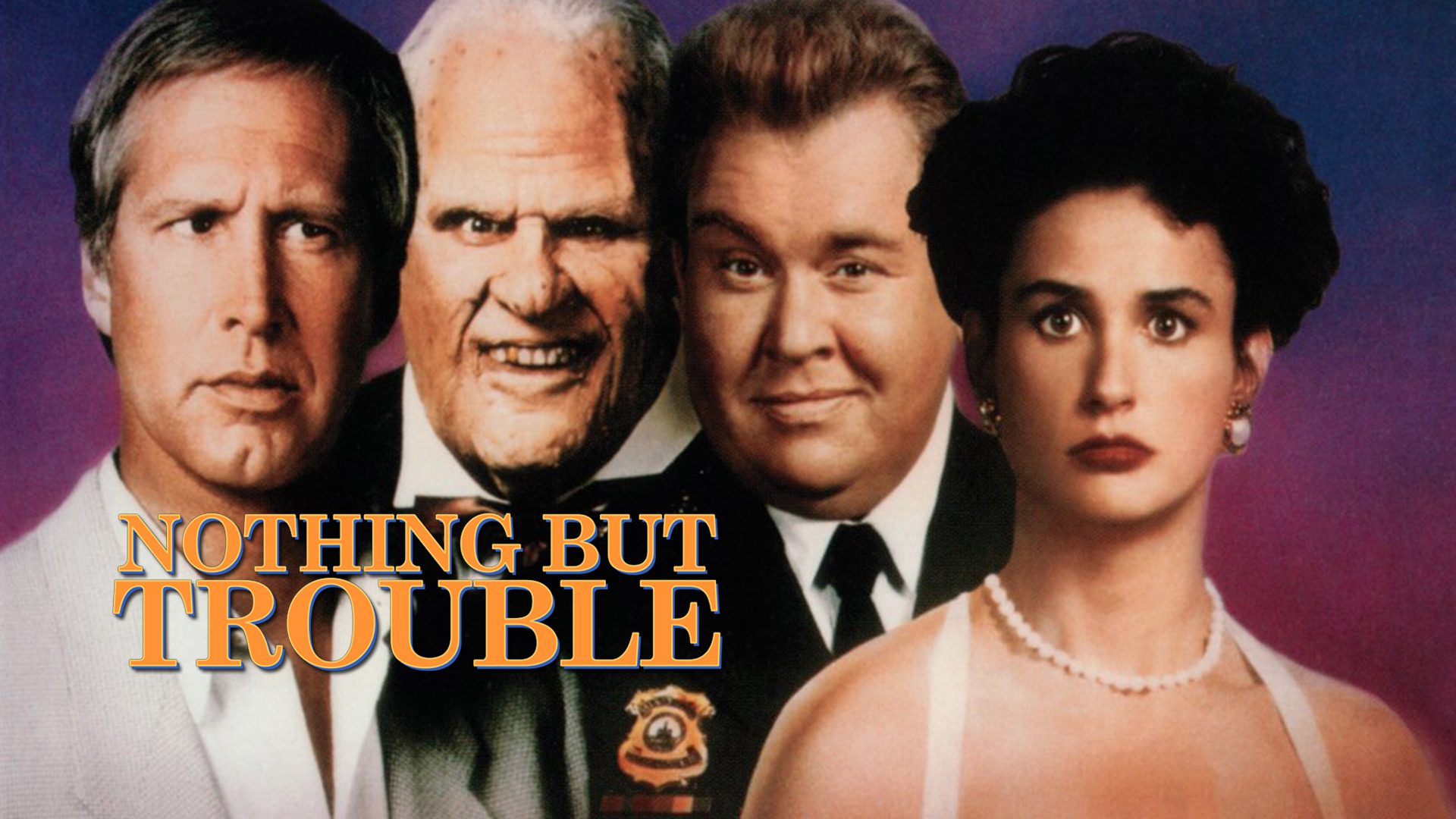
In Nothing But Trouble, (released in theaters on Feb. 15, 1991), financial publisher Chris Thorne (Chevy Chase) and savvy attorney Diane Lightson (Demi Moore) find their lives taking a terrifyingly wrong turn.
After taking a detour through the backroads of New Jersey on their way to Atlantic City, they are pulled over for a minor traffic violation in the decaying, industrial wasteland of Valkenvania.
They are hauled before the ancient, 106-year-old Judge Alvin “J.P.” Valkenheiser (Dan Aykroyd), a grotesque patriarch who presides over an estate filled with lethal traps and junk-yard machinery designed to execute those who cross his path.
The plot becomes a fever dream as Chris and Diane are held captive alongside two wealthy Brazilians, soon discovering that the Judge’s courtroom is a charade for a personal house of horrors.
The estate is guarded by the Judge’s silent granddaughter and his two giant, mutant grandsons, Bobo and Lil’ Debbull (also played by Aykroyd).
Among the few friendly faces is the local constable, Dennis (John Candy), and his sister Eldona (also Candy), though their loyalty is constantly tested by the Judge’s tyrannical rule.
Directed by Aykroyd himself, the film features a bizarre guest appearance by Digital Underground, including a young Tupac Shakur, who are forced to perform for the Judge to win their freedom.
The narrative follows Chris and Diane’s desperate, slapstick attempts to escape the Judge’s “Mr. Bonestripper” machine and flee the literal and figurative scrapheap of Valkenvania.
Taylor Negron, Raymond J. Barry and Daniel Baldwin round out the cast.
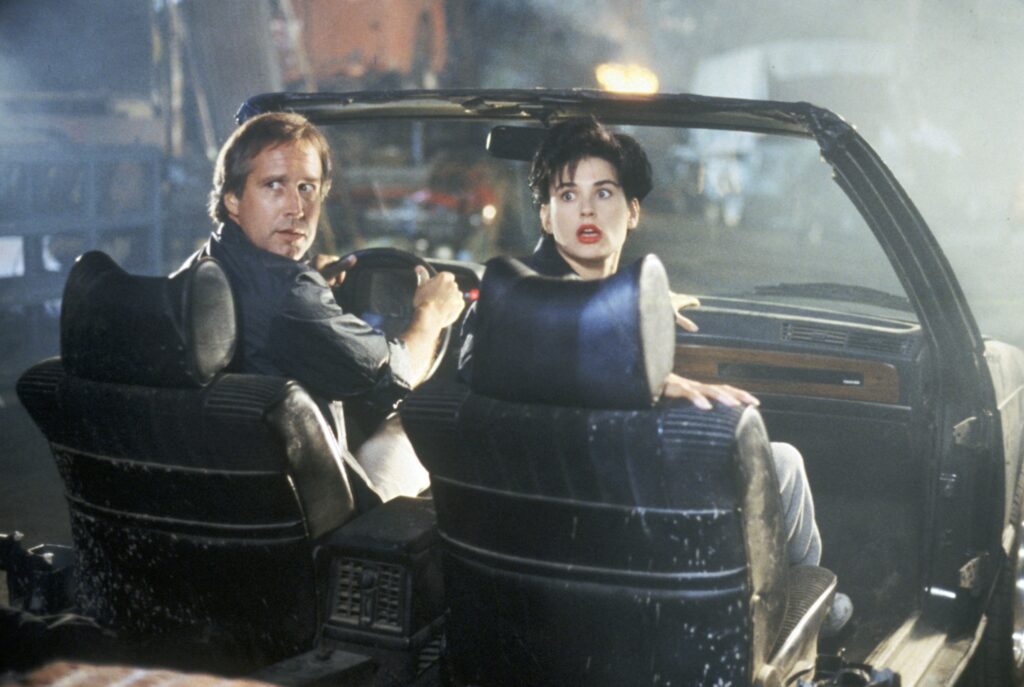
Chevy Chase and Demi Moore in Nothing But Trouble (Photo/Warner Bros.)
Reception for Nothing But Trouble
Nothing But Trouble grossed $4 million on its opening weekend, finishing eighth at the box office.
The film would gross $8.5 million in its theatrical run.
Legacy
The legacy of Nothing But Trouble is one of the most fascinating in 1990s cinema, evolving from a high-profile box-office failure into a significant cult classic.
Upon its release, audiences were baffled by its dark, “funhouse” aesthetic and Aykroyd’s heavy prosthetic makeup, but in the decades since, it has been reclaimed as a masterpiece of grotesque production design and unbridled creative eccentricity.
It stands as a unique outlier in the careers of stars like Chase and Moore, offering a glimpse into a brand of high-concept, nightmarish comedy that major studios rarely greenlight today.
The film remains a polarizing yet essential watch for fans of “bad” cinema and midnight movies, celebrated for its sheer commitment to a vision that is both repulsively ugly and undeniably imaginative.