



Little Big League (released on June 29, 1994), which opened in theaters during the “kid-wish-fulfillment” sports movies, stands out as the most sophisticated and reverent toward the game of baseball itself. It avoids the slapstick of its contemporaries, opting instead for a story that treats the sport and its young protagonist with genuine intelligence and a touch of melancholy.
The story follows Billy Heywood (Luke Edwards), a twelve-year-old baseball fanatic whose life is upended when his grandfather, Thomas Heywood (Jason Robards), passes away.
To the world’s surprise, Thomas leaves the ownership of the Minnesota Twins to Billy.
After firing the abrasive manager George O’Farrell (Dennis Farina), Billy realizes that nobody knows the team’s nuances better than he does, so he appoints himself as the new manager.
The transition isn’t easy.
Billy must navigate the egos of professional athletes, including the star first baseman Lou Collins (Timothy Busfield), who is also pursuing Billy’s mother (Ashley Crow).
With the help of the coaching staff led by pitching coach Mac Macnally (John Ashton), Billy uses his encyclopedic knowledge of the game to turn the cellar-dwelling Twins into contenders.
Supporting turns from Kevin Dunn as the GM Arthur Goslin, Jonathan Silverman as reliever Jim Bowers, and Duane Davis as the powerhouse Jerry Johnson add layers of authenticity to the clubhouse.
However, as the pennant race heats up, Billy begins to lose his childhood to the stresses of a high-stakes job, leading to a climax that explores the heavy price of getting exactly what you wished for.
John Minch, Scott Patterson and Wolfgang Bodison round out the supporting cast.
Former Major League Baseball shortstop Kevin Elster and first baseman Leon Durham also starred as Twins’ players.
Ken Griffey Jr., Ivan Rodriguez, Wally Joyner, Chris Berman, Paul O’Neill, Mickey Tettleton, Sandy Alomar Jr, and Randy Johnson all have cameos as themselves.
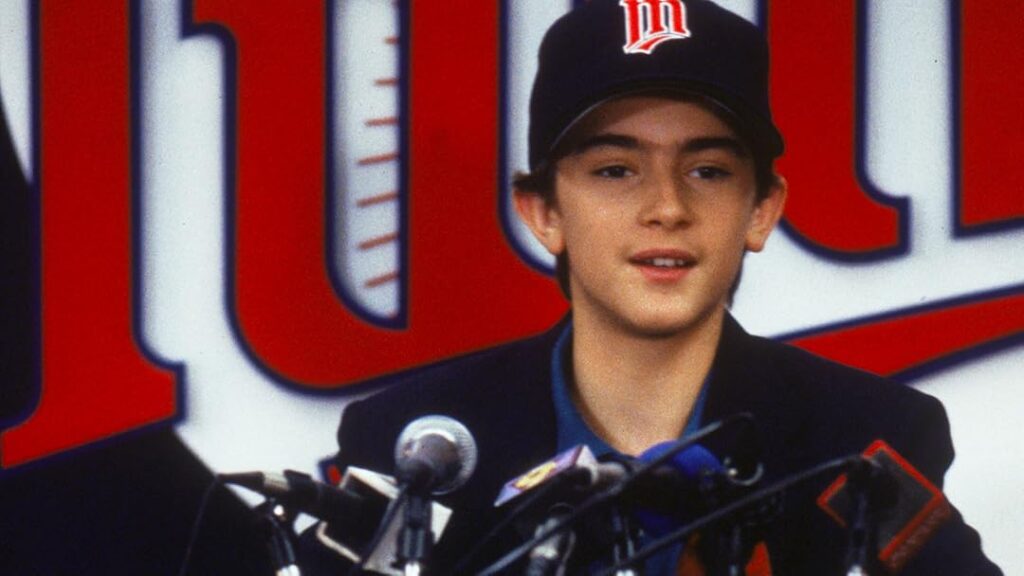
Little Big League (Photo/Columbia Pictures)
Reception for Little Big League
Little Big League grossed $3.1 million on its opening weekend, finishing tenth at the box office.
The film would gross $12.3 million in its theatrical run.
Roger Ebert gave Little Big League three and a half out of four stars in his review, saying “Little Big League has the same mystical regard for the game as movies like Field of Dreams and Bull Durham.”
Legacy
Little Big League‘s legacy is defined by its deep respect for the technicalities of baseball.
Unlike many films that rely on “magic” or impossible physics, this movie features actual strategic maneuvers, such as the hidden ball trick and complex relief pitching rotations.
Beyond the diamond, the film is remembered for its emotional maturity.
It refuses to give the audience a fairy-tale ending, instead offering a bittersweet lesson about the importance of being a kid while you still can.
By balancing the fantasy of managing a major league team with the grounded reality of growing up, it has secured its place as a perennial favorite for fans who appreciate the “thinking man’s” version of the sports comedy.