



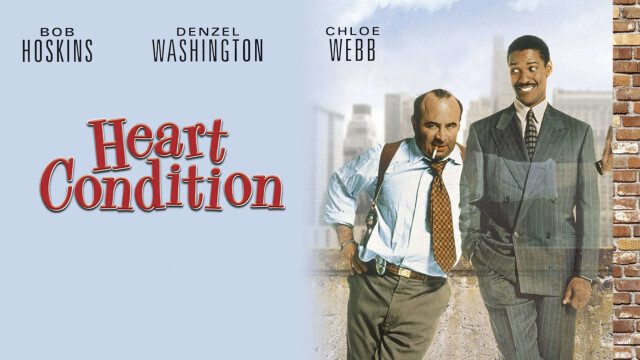
In the genre-bending Heart Condition (released in theaters on Feb. 2, 1990), Jack Moony (Bob Hoskins) is a bigoted, cheeseburger-shoveling Los Angeles police detective whose lifestyle is a ticking time bomb. Moony’s professional and personal life is defined by his intense hatred for Napoleon Stone (Denzel Washington), a smooth-talking, charismatic lawyer with ties to the criminal underworld and an intimate history with Moony’s former flame, Crystal (Chloe Webb).
The plot takes a surreal turn when Moony suffers a massive heart attack at the exact moment Stone is killed in a mysterious drive-by shooting. Moony wakes up from surgery to find he has been given a second chance at life via a heart transplant—and the donor is none other than his arch-nemesis, Stone.
The situation becomes even more complicated when Stone returns as a ghost that only Moony can see and hear. Forced into an unwanted partnership, the two must bridge their deep-seated racial and ideological divides to solve Stone’s murder.
As they navigate the gritty streets of L.A., dealing with figures like Captain Wendt (Roger E. Mosley) and the shady Dr. Posner (Alan Rachins), Stone attempts to coach Moony into a healthier lifestyle while Moony seeks justice for his donor.
Along the way, they uncover a conspiracy that reaches into the upper echelons of the city.
Clayton Landey and Eva LaRue round out the cast.
Directed by James D. Parriott, the film utilizes its supernatural premise to explore themes of redemption and the literal change of heart required to overcome prejudice.
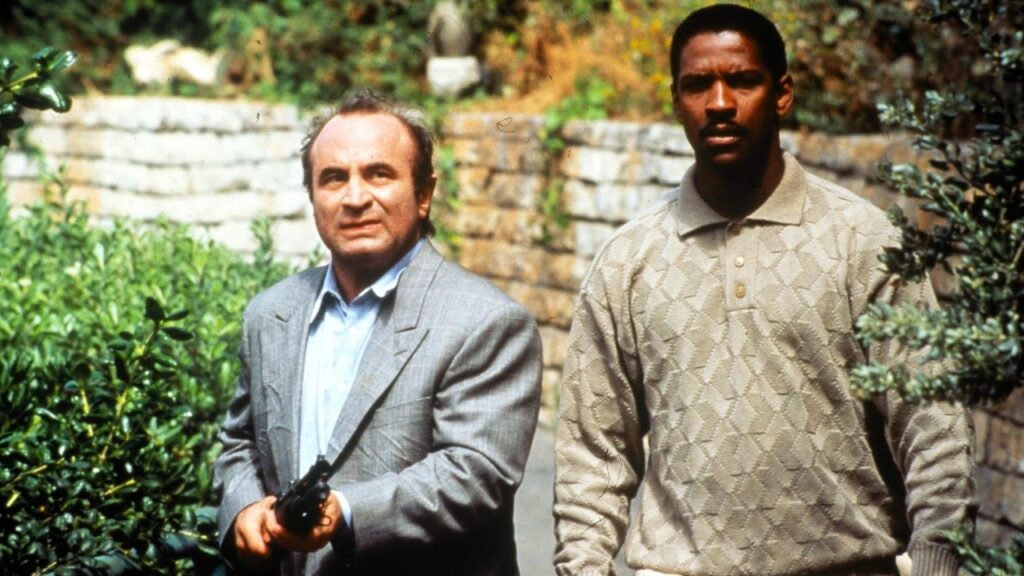
Bob Hoskins and Denzel Washington in Heart Condition (Photo/New Line Cinema)
Reception for Heart Condition
Heart Condition grossed $2.1 million on its opening weekend, finishing ninth at the box office.
The film would gross $4.1 million in its theatrical run.
Roger Ebert gave Heart Condition two out of four stars in his review.
Legacy
Heart Condition is defined by its status as a daring, if unconventional, exploration of race relations disguised as a high-concept buddy-cop comedy.
Released in 1990, it arrived at a pivotal moment for its lead actors; for Washington, it was one of the last “lighthearted” roles he took before his ascent into heavy dramatic superstardom, showcasing a comedic timing and debonair charm that remains a highlight of his early filmography.
Hoskins, meanwhile, delivered a nuanced performance that balanced physical comedy with a believable internal evolution.
It stands as a unique artifact of early-90s cinema, remembered for its bizarre premise and the undeniable screen chemistry between two of the era’s most formidable talents.