

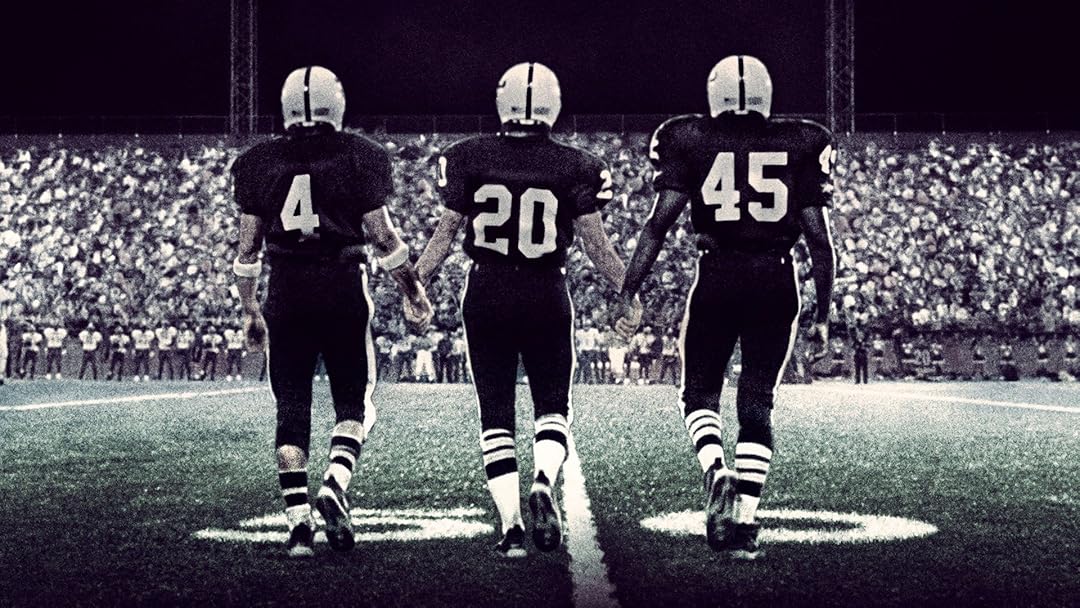
Friday Night Lights (released in theaters on October 8, 2004) redefined the sports movie genre by stripping away the glossy idealism often associated with high school athletics. Directed by Peter Berg and based on H.G. Bissinger’s non-fiction masterpiece Friday Night Lights: A Town, a Team, and a Dream, the film is a visceral, documentary-style exploration of the 1988 Permian High School Panthers. It is less about the glory of the game and more about the crushing weight of expectation placed upon teenage shoulders in Odessa, Texas—a town where “winning” isn’t a goal, but a desperate social necessity.
The story centers on Coach Gary Gaines (Billy Bob Thornton), a man who carries the hopes of an entire city on his back.
His team is led by the immensely talented running back Boobie Miles (Derek Luke), whose path to college stardom seems certain until a devastating knee injury shatters his future.
This tragedy forces the team to find a new identity, leaning on the quiet, stoic quarterback Mike Winchell (Lucas Black) and the hardworking but overlooked Don Billingsley (Garrett Hedlund).
Don’s struggle is intensified by his abusive, alcoholic father, Charles (Tim McGraw), a former champion who lives vicariously and violently through his son.
As the Panthers navigate a grueling season toward the state championship, the film captures the personal trials of the roster.
Safety Brian Chavez (Jay Hernandez) balances academic brilliance with the brutality of the field, while Maria (Amber Heard) watches the toll the sport takes on her peers.
Behind the scenes, Sharon Gaines (Connie Britton) provides the emotional anchor for her husband as the town’s boosters grow increasingly hostile with every loss.
Lee Thompson Young stars as Chris Comer, the third string tailback that shines in the Permian offense.
Lee Jackson plays Ivory Christian, the Panthers’ star defensive end.
The narrative builds to a heart-pounding climax in the Astrodome, where the undersized Panthers face a monolithic opponent.
The game serves as a final, brutal rite of passage, forcing these boys to realize that while the lights may fade, the character they forged in the heat of Odessa will remain.
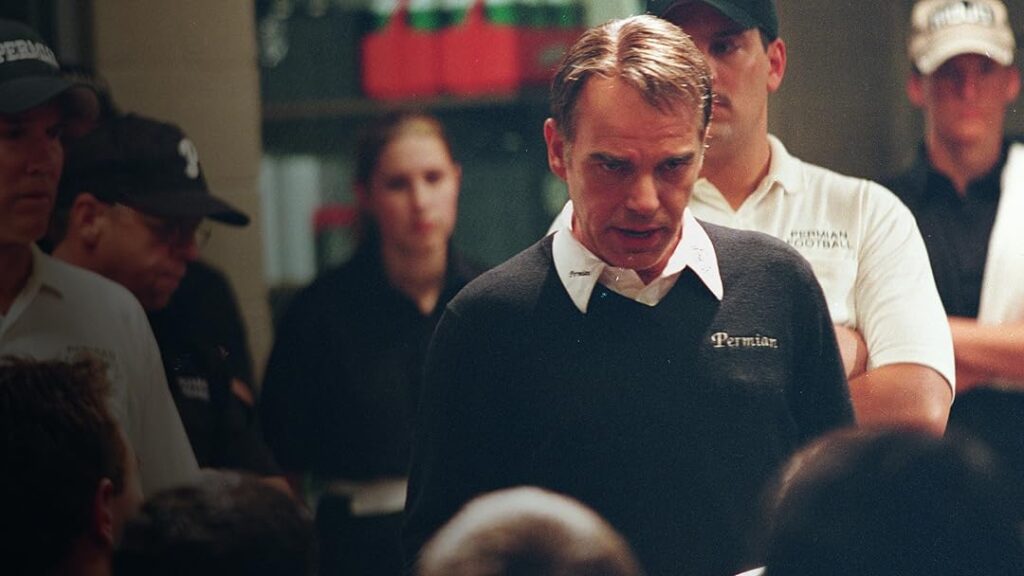
Billy Bob Thornton in Friday Night Lights (Photo/Universal Pictures)
Reception for Friday Night Lights
Friday Night Lights grossed $22.4 million on its opening weekend, finishing second at the box office.
The film would gross $61.3 million in its domestic theatrical run.
Roger Ebert the film three and a half out of four stars in his review.
The film won the Best Sports Movie ESPY Award.
Legacy
The legacy of Friday Night Lights is its profound impact on both cinema and television, serving as the direct inspiration for the beloved, long-running TV series of the same name.
It is widely regarded as one of the most accurate depictions of Texas football culture ever filmed, praised for its handheld cinematography and “lived-in” aesthetic that made the audience feel the dust and the impact of every tackle.
Beyond the screen, the movie’s legacy lies in its honest treatment of the “glory days” mythos, acknowledging that for many of these young men, high school is the peak of their lives.