








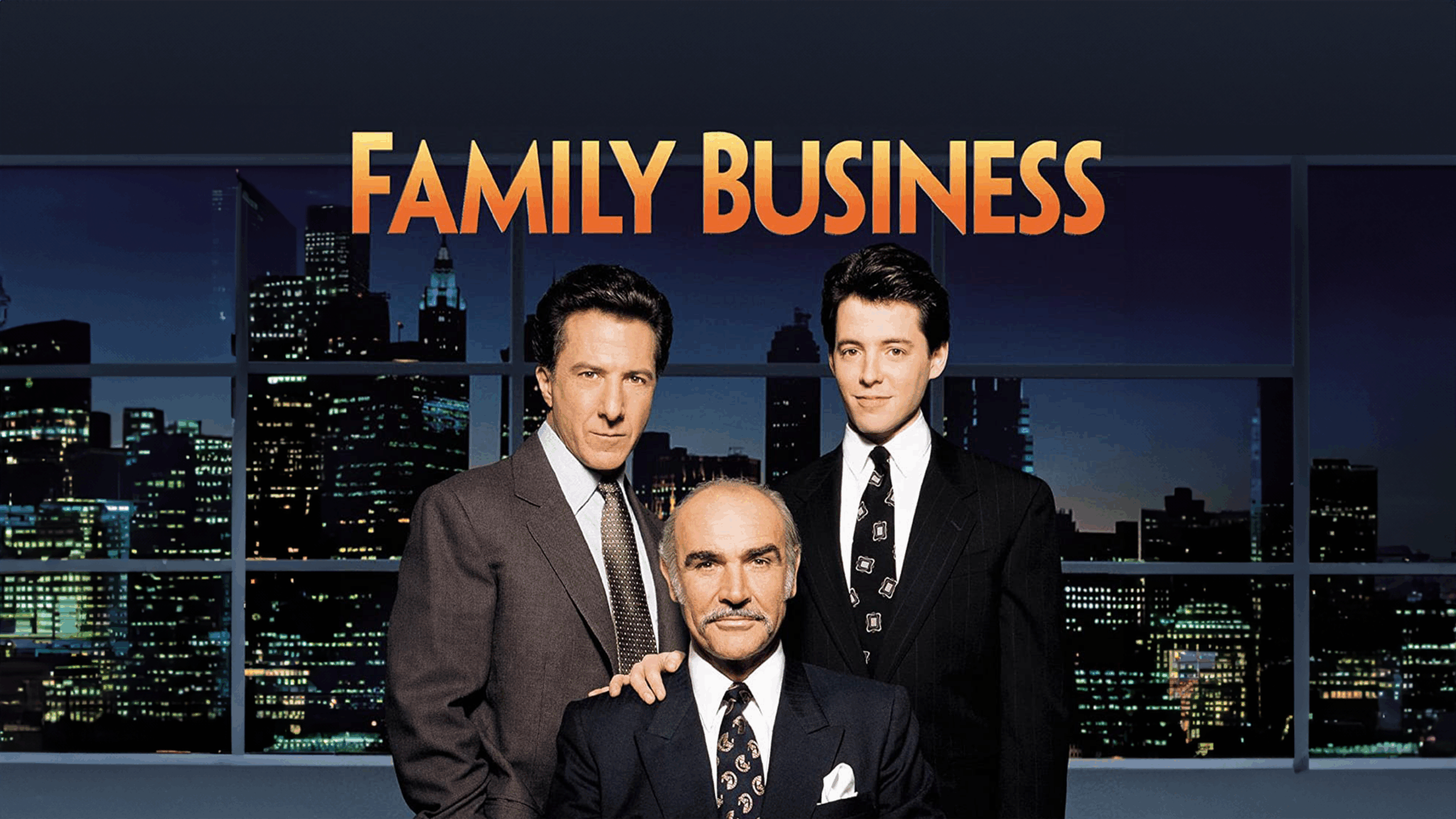
Family Business (released in theaters on Dec. 15, 1989) explores the complicated DNA of the McMullen family, a trio of men defined by their conflicting attitudes toward the law. Directed by the legendary Sidney Lumet, the film stars Sean Connery as Jessie, a charming, unrepentant Irish-American thief who has spent his life in and out of prison. His son, Vito (Dustin Hoffman), has spent his adulthood trying to go straight, running a successful wholesale meat business and distancing himself from his father’s criminal influence.
The generational divide is bridged and then collapsed by Adam (Matthew Broderick), Vito’s son and Jessie’s grandson.
Adam is a brilliant college student with a bright, legal future ahead of him, yet he finds himself seduced by the romanticism of his grandfather’s outlaw lifestyle.
Adam approaches Jessie with a plan for a “perfect” million-dollar heist involving a scientific laboratory.
Vito is initially horrified, but out of a misguided desire to protect his son from Jessie’s recklessness, he eventually agrees to join the caper to ensure everything goes smoothly. The heist itself—stealing a valuable biological research project—serves as the backdrop for the shifting dynamics between the three men.
Janet Carroll, Victoria Jackson, Deborah Rush, James Tolkan, Luis Guzman, B.D. Wong and Wendell Pierce round out the supporting cast.
As the pressure of the crime mounts, the simmering resentments and deep-seated loyalties of the McMullen men come to a head, leading to a botched job that forces them to confront the true cost of their “family business.”

Dustin Hoffman in Family Business (Photo/TriStar Pictures)
Reception for Family Business
Family Business grossed $2.1 million on its opening weekend, finishing sixth at the box office.
The film would gross $12.2 million in its theatrical run.
Roger Ebert gave Family Business three out of four stars in his review.
Legacy
Despite the powerhouse trio of Connery, Hoffman, and Broderick, Family Business received a lukewarm reception upon its release. Critics and audiences struggled with the film’s tonal shifts between lighthearted caper and heavy family drama. However, its legacy has matured into that of a fascinating “what if” in cinema history, primarily valued for the rare opportunity to see three generations of acting royalty share the screen.
The film is a testament to Lumet’s career-long obsession with the moral decay of New York City and the complexities of father-son relationships. Connery steals the show with a boisterous, charismatic performance that serves as the film’s engine, while Hoffman provides a grounded, neurotic counterpoint.
Family Business is remembered as a polished, character-driven piece that prioritizes dialogue and psychological friction over high-octane action.
It remains a poignant, if imperfect, exploration of how the sins—and the charms—of the father are visited upon the sons and stands as a notable entry in the late careers of its stars, offering a bittersweet look at the ties that bind and the legacies we can’t escape.