


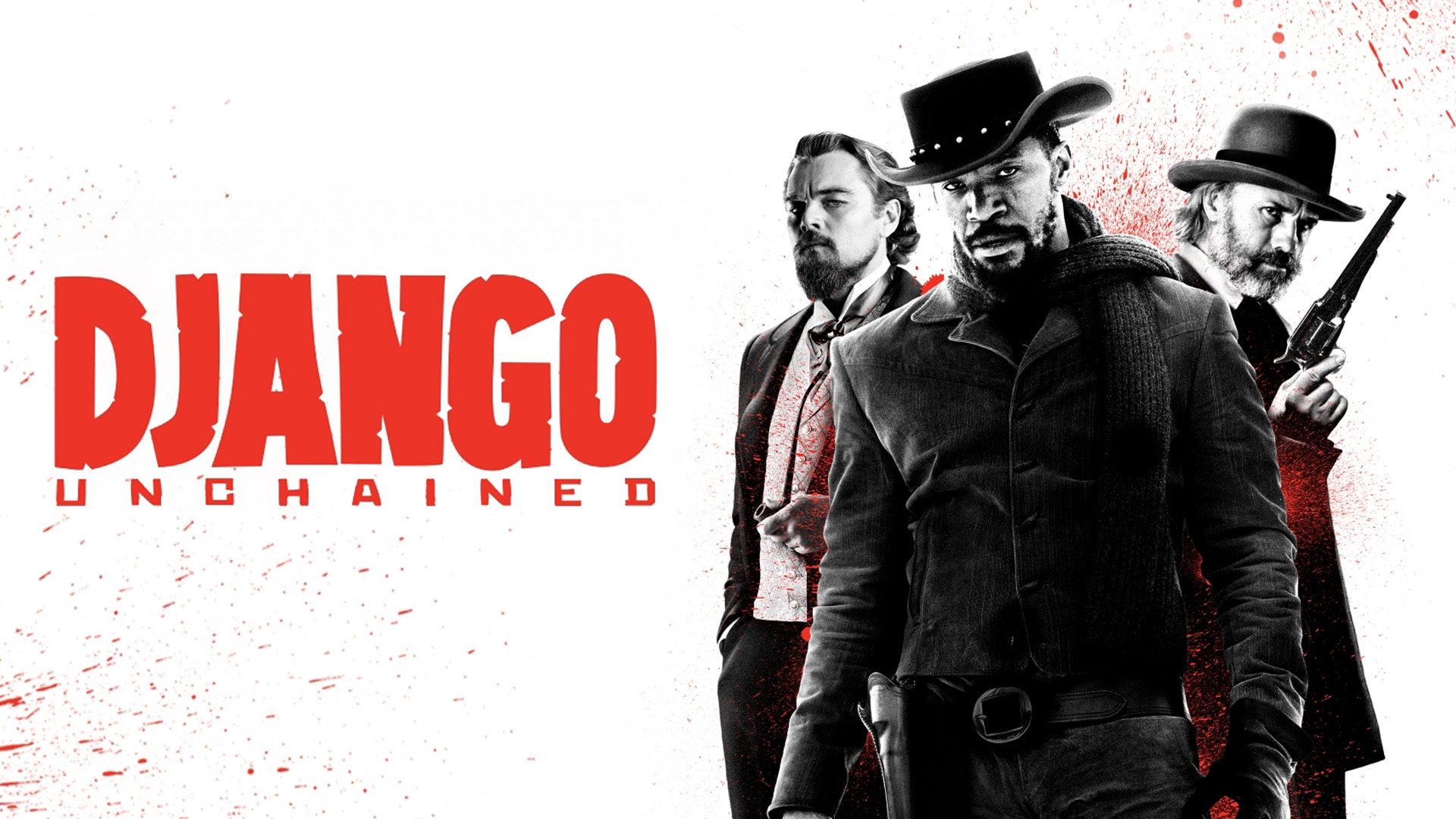
Quentin Tarantino’s Django Unchained (released in theaters on Dec. 25, 2012) reimagines the spaghetti western through the lens of America’s darkest chapter, unleashing a film that balances grim historical resonance with stylish vengeance. The result is both a love letter to the genre and a daring provocation that turns moral outrage into artful catharsis.
Set two years before the Civil War, the story follows Django (Jamie Foxx), a slave rescued by Dr. King Schultz (Christoph Waltz), a German bounty hunter masquerading as a dentist.
Schultz recognizes Django’s resilience and enlists him as a partner in hunting fugitives across the frontier.
Their unlikely camaraderie—built on mutual respect rather than subjugation—becomes the film’s emotional center. Django’s goal, however, runs deeper: to rescue his wife, Broomhilda (Kerry Washington), still enslaved on the notorious Candyland plantation.
Candyland’s master, Calvin Candie (Leonardo DiCaprio), embodies charm twisted into cruelty.
Beneath his genteel façade lies sociopathic sadism, surrounded by sycophants like the conniving Stephen (Samuel L. Jackson), whose self-serving loyalty to Candie adds a biting layer of internalized oppression.
When Django and Schultz infiltrate this hellish estate under false pretenses, Tarantino constructs a tension-filled masquerade—culminating in an eruption of violence so operatic it borders on mythic.
Tarantino directs the chaos with his characteristic flair: operatic music cues, whip-crack editing, and humor laced with discomfort.
Yet the film’s violence, often cartoonish, underscores rather than trivializes the horrors it depicts.
Waltz’s urbane Schultz provides moral sophistication, balancing Django’s emerging ferocity.
Foxx embodies transformation flawlessly—from broken man to empowered avenger—his performance grounded in stoic determination rather than bravado.
DiCaprio revels in villainy, and Jackson chills with quiet menace, his subservience disguising control.
The dialogue dances between elegance and vulgarity, constructing a myth about freedom and payback with pulp energy.
Don Johnson also appears as Spencer “Big Daddy” Bennett.
Walton Goggins, Dennis Christopher, James Remar, Franco Nero, James Russo, Tom Wopat, Don Stroud, Bruce Dern, M.C. Gainey, Jonah Hill, Lee Horsley, Rex Linn, Michael Bowen, Robert Carradine, and Tom Savini round out the supporting cast.
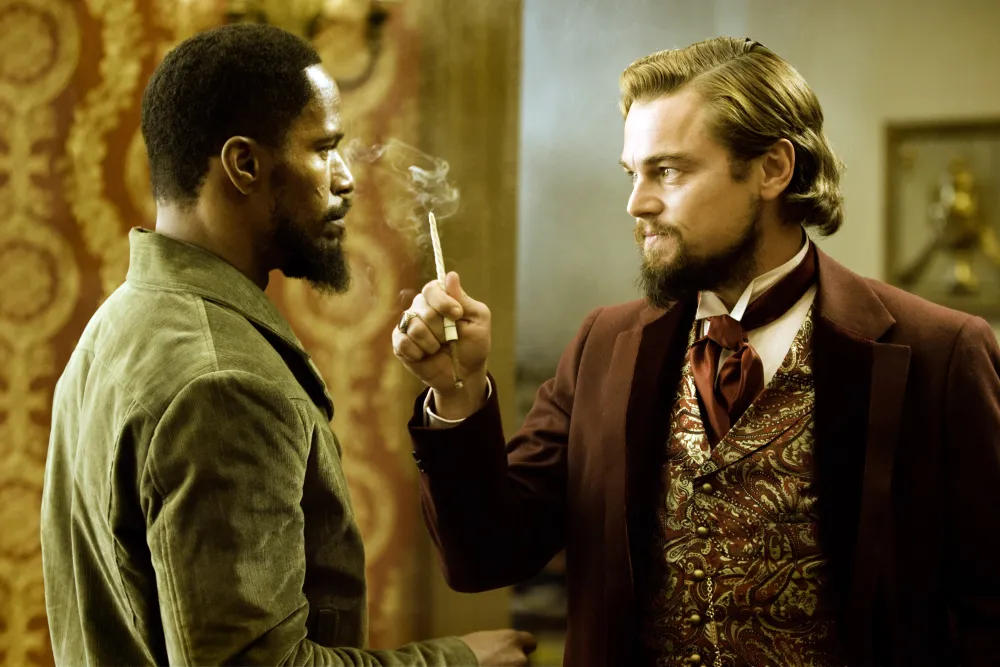
Jamie Foxx and Leonardo DiCaprio in Django Unchained (Photo/The Weinstein Company)
Reception for Django Unchained
Django Unchained grossed $15 million on its opening weekend, finishing fifth at the box office.
The following week, the film would improve to $44.5 million and second in the box office.
Django Unchained grossed $425.4 million worldwide.
The film is Tarantino’s highest-grossing film and the highest grossing Western film of all-time, topping Dances With Wolves, which earned $424.2 million worldwide.
Roger Ebert gave the film four out of four stars in his review.
Legacy
Django Unchained stands as one of Tarantino’s boldest achievements, earning him Oscars for Best Original Screenplay and Waltz’s supporting role.
More than a revenge tale, it reclaims the western as a space for Black heroism, amplifying history’s silenced voices through cinematic spectacle.
Over a decade later, it endures as a thrilling, uncomfortable, and strangely redemptive reckoning with America’s past, a blood-soaked liberation myth only Tarantino could stage.