







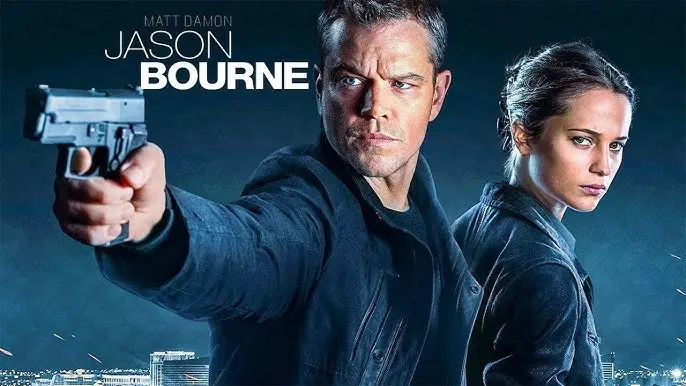
Jason Bourne (released in theaters on July 29, 2016) finds the titular former CIA assassin (Matt Damon) living completely off the grid, scraping by as an underground, bare-knuckle fighter in Greece.
His self-imposed isolation is shattered when his old ally, Nicky Parsons (Julia Stiles), hacks into the CIA’s mainframe and tracks him down to deliver stolen, highly classified files regarding Black Ops recruitment programs.
Nicky reveals that Bourne’s own late father was the mastermind behind the original Treadstone project, indicating that Bourne was targeted for manipulation long before he volunteered.
Their clandestine meeting in Athens is violently disrupted by the agency, culminating in a chaotic, fiery riot through the streets where Nicky is tragically gunned down by a ruthless Black Ops assassin known simply as the Asset (Vincent Cassel).
The plot accelerates into a global game of cat-and-mouse as CIA Director Robert Dewey (Tommy Lee Jones) orders Bourne’s immediate termination, while Heather Lee (Alicia Vikander), the ambitious, tech-savvy head of the Cyber Intelligence Division, argues that it is more valuable to bring the rogue agent back into the fold.
As Bourne travels across Europe to piece together the truth about his father, the narrative weaves in a modern conspiracy involving Aaron Kalloor (Riz Ahmed), a Silicon Valley social media billionaire who is being blackmailed by Dewey to integrate a pervasive government surveillance backdoor into his new platform.
Supported by tactical agents Craig Jeffers (Ato Essandoh) and Director of National Intelligence Edwin Russell (Scott Shepherd), the competing factions collide at a high-tech convention in Las Vegas.
The film builds to a pulverizing, destructive climax featuring a massive SWAT vehicle chase down the Strip, forcing Bourne to confront Dewey, settle his bloody score with the Asset, and outsmart Lee’s calculating political traps.
Director Paul Greengrass returns to the franchise with his signature, hyper-kinetic “shaky-cam” cinematography and documentary-style realism, mounting intensely visceral action sequences.
Damon steps back into his most famous role with a weathered, muscular gravity, conveying deep psychological pain with very few lines of dialogue.
Jones commands his scenes with a cold, terrifying bureaucratic malice, while Vikander adds an excellent, morally ambiguous layer of corporate ambition to the intelligence apparatus.
Jason Bourne follows the original trilogy of The Bourne Identity (2002), The Bourne Supremacy (2004) and The Bourne Ultimatum (2007).

Matt Damon and Julia Stiles in Jason Bourne (Photo/Universal Pictures)
Reception for Jason Bourne
Jason Bourne grossed $59.2 million on its opening weekend, finishing No. 1 at the box office.
The film would gross $415.5 million worldwide.
Richard Roeper gave Jason Bourne three and a half out of four stars in his review.
Legacy
Jason Bourne‘s legacy rests on its status as a monumental box office triumph that successfully proved the enduring cultural power of its central hero, cementing the franchise as a permanent pillar of modern action cinema.
Arriving nearly a decade after the original trilogy concluded, it brilliantly updated the series’ signature geopolitical themes to reflect a post-Snowden world defined by massive digital data privacy debates, cyber-warfare, and corporate tech surveillance.
The movie is highly celebrated by stunt coordinators and genre purists for its staggering, masterfully orchestrated practical car crashes on the streets of Las Vegas, which stand among the most ambitious vehicular stunts ever captured on film.
Jason Bourne remains a fascinating, adrenaline-fueled artifact of its era, continually praised for its uncompromising grit, its relentless pacing, and its cold, realistic depiction of contemporary international espionage.