













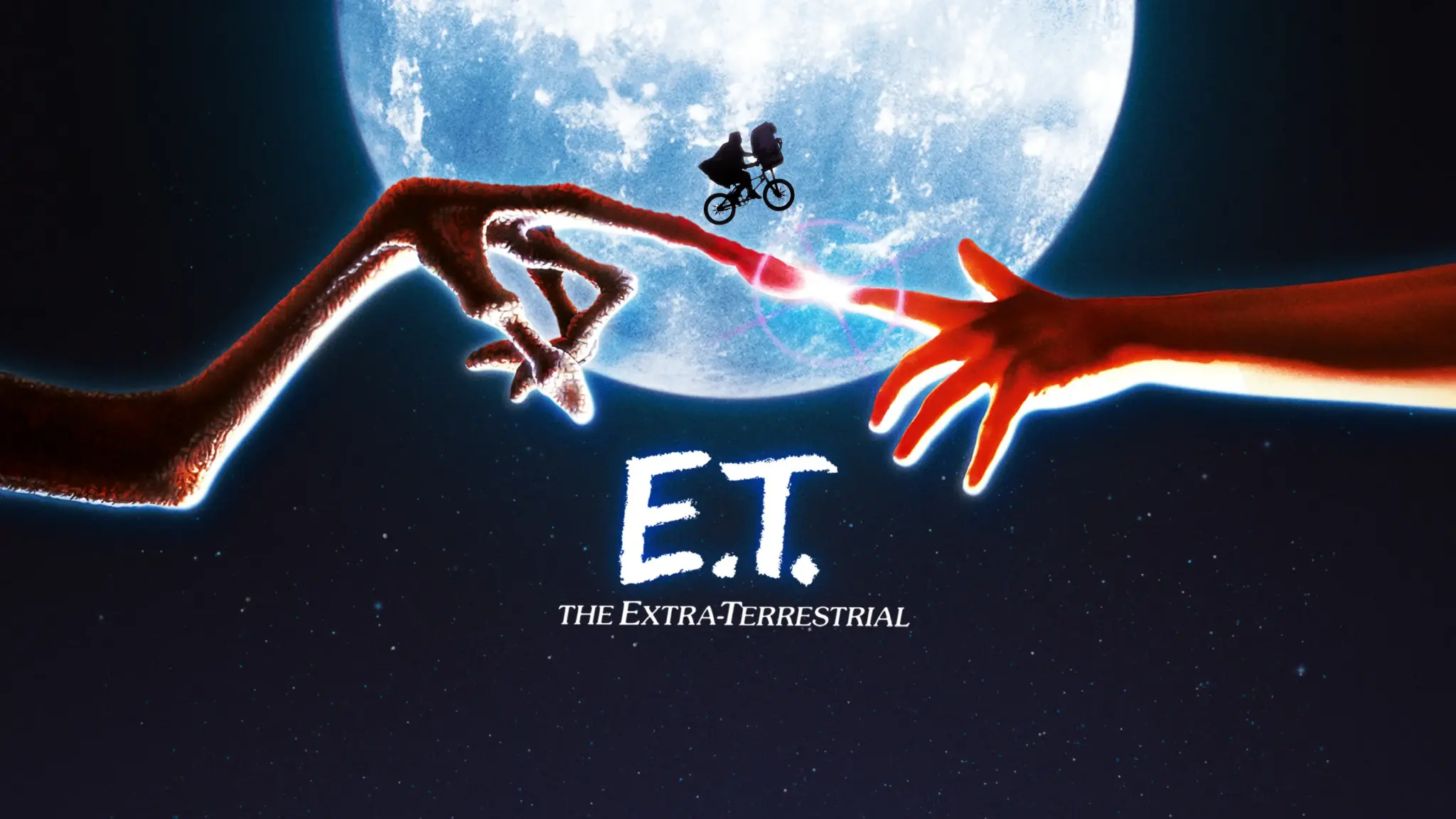
E.T. the Extra-Terrestrial (released in theaters on June 11, 1982) begins in a shadowed California forest, where a group of alien botanists is forced to flee in their spacecraft, accidentally stranding one of their gentle companions on Earth.
The frightened creature wanders into a nearby suburban neighborhood, where he is discovered by Elliott (Henry Thomas), a lonely ten-year-old boy coping with his parents’ recent separation.
Elliott secretly brings the alien into his bedroom, earning his trust with a trail of candy.
Soon, Elliott introduces the creature to his skeptical older brother, Michael (Robert MacNaughton), and his energetic little sister, Gertie (Drew Barrymore).
Together, the children vow to protect their new friend, whom they name E.T., keeping him hidden from their stressed, hardworking mother, Mary (Dee Wallace).
The plot deepens as an extraordinary, empathetic psychic bond develops between Elliott and E.T., allowing the boy to feel the alien’s physical sensations and emotions.
Homesick and fading, E.T. learns to speak basic English and constructs a crude communication device using an umbrella and electronic toys to “phone home.”
The narrative shifts into a high-stakes thriller when government agents, led by a compassionate investigator known as Keys (Peter Coyote), track E.T. down and invade the family home with a massive medical quarantine unit.
As both Elliott and the alien fall critically ill from the strain of Earth’s environment, the children refuse to give up.
Michael and his neighborhood friends orchestrate a daring escape on their bicycles, leading to a breathtaking, gravity-defying flight over the police barricades and into the forest, where E.T.’s spaceship finally returns for a heartbreaking farewell.
Director Steven Spielberg directs with unparalleled emotional precision, framing the entire story from a child’s eye level to maximize the sense of wonder and vulnerability.
Thomas delivers one of the greatest child performances in film history, radiating pure sincerity, while Barrymore provides an abundance of natural, comedic charm.
Carlo Rambaldi’s brilliant animatronic puppet design gives E.T. a soulful, expressive face that completely transcends its special-effects origins.
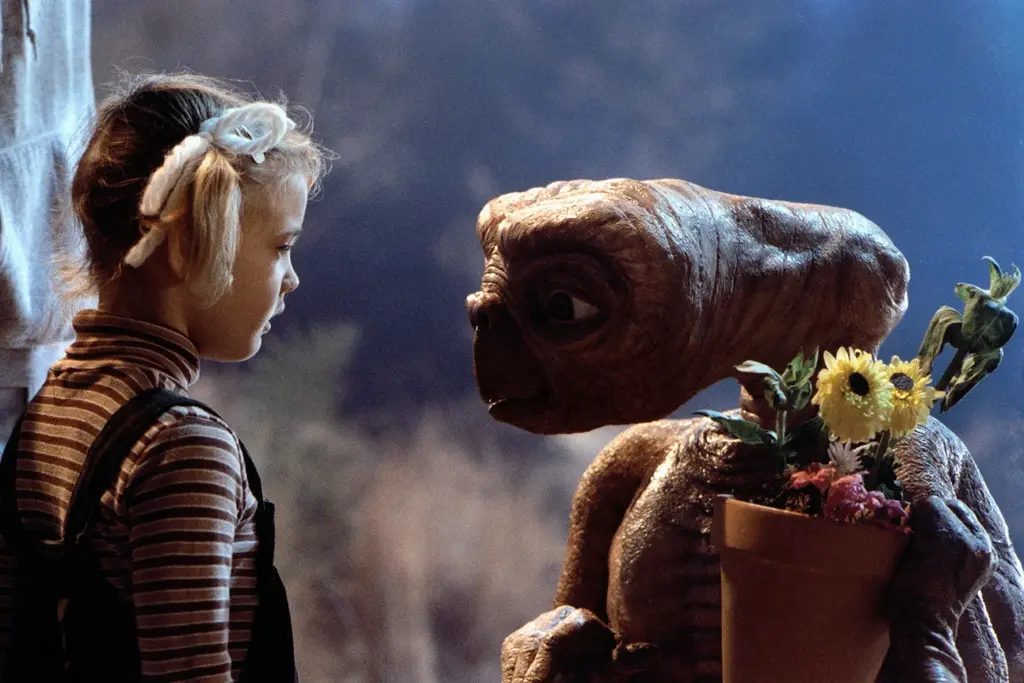
E.T. the Extra Terrestrial (Photo/Universal Pictures)
Reception for E.T. the Extra-Terrestrial
E.T. the Extra-Terrestrial grossed $11.8 million on its opening weekend, finishing No. 1 at the box office.
The film would remain No. 1 at the box office for 14 of its first 19 weeks and in the top 10 for 38 of its first 39 weeks en route to grossing $797.3 million worldwide.
Roger Ebert gave E.T. the Extra-Terrestrial four out of four stars in his review.
Lasting Legacy
E.T. the Extra-Terrestrial‘s legacy is monumental, standing permanently as one of the most culturally significant and universally beloved cinematic achievements ever made.
Upon its release, it surpassed Star Wars to become the highest-grossing movie of all time, a record it held for a decade.
John Williams’s sweeping, Oscar-winning musical score contains what is arguably the most triumphant and emotionally devastating brass crescendo in Hollywood history, synonymous with the magic of cinema itself.
By utilizing a science-fiction premise to explore intimate, real-world themes of childhood loneliness, healing from divorce, and the power of absolute empathy, Spielberg created a permanent piece of global folklore.
Decades later, the image of the flying bicycle against a full moon remains the definitive symbol of cinematic imagination, continuing to shape the visual grammar of modern storytelling.