
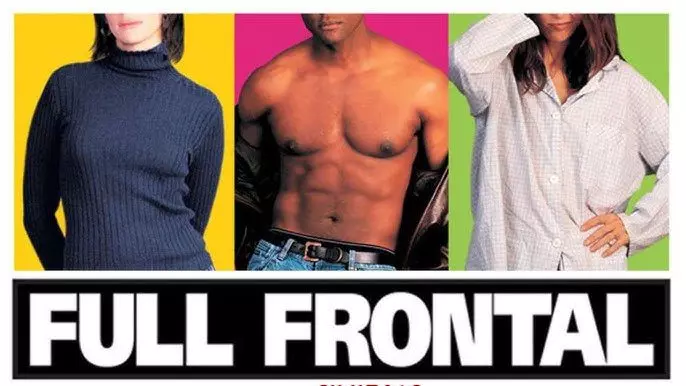
Full Frontal (released in theaters on August 2, 2002), sees director Steven Soderbergh presenting a “film-within-a-film” structure that blurs the lines between reality and fiction.
The plot follows several interconnected characters over the course of a single day in Los Angeles.
At the center is a movie production titled Rendezvous, starring Francesca (Julia Roberts) as an actress playing a journalist and Calvin (Blair Underwood) as an actor playing her subject.
Surrounding this fictional production are the “real” lives of those involved: Lee (Catherine Keener), a high-strung human resources executive on the verge of a breakdown, and her husband Carl (David Hyde Pierce), a writer struggling with his own creative frustrations.
As the day unfolds, the narrative weaves through various vignettes. Linda (Mary McCormack), Lee’s sister and a massage therapist, deals with an awkward encounter with a client, Bill (David Duchovny), who has a specific and unusual fetish.
Meanwhile, an eccentric actor named Arty (Nicky Katt) prepares for a play, and Brad Pitt makes an appearance as himself, further complicating the layers of celebrity and performance.
The film utilizes a distinct visual style, shooting the “real world” scenes on grainy digital video and the Rendezvous scenes on polished 35mm film.
The plot culminates at a birthday party for a producer, where the various professional and personal threads collide, revealing the inherent artifice and fragility of the Hollywood ecosystem.
David Fincher appears as the film director.
Jeff Garlin, Terence Stamp, Jerry Weintraub, Rainn Wilson and January Jones round out the cast.
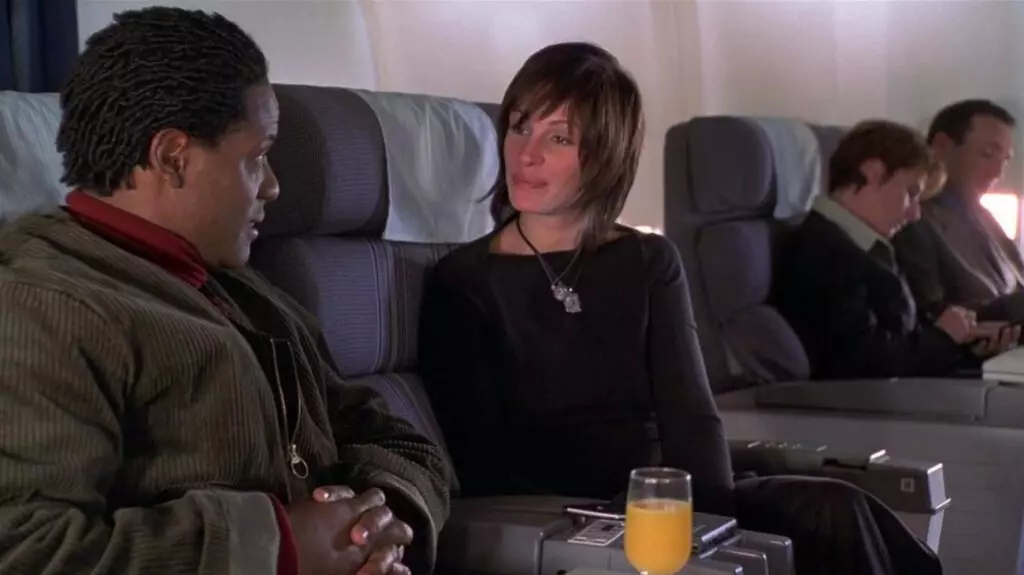
Blair Underwood and Julia Roberts in Full Frontal (Photo/Miramax)
Reception for Full Frontal
Full Frontal grossed $739,834 on its opening weekend, finishing 19th at the box office in limited release. The highest grossing film of the weekend was Signs starring Mel Gibson, which earned $60.1 million on its first weekend.
The film would gross $2.5 million in its theatrical run.
Legacy
Full Frontal‘s legacy is defined by its role as a bold, avant-garde experiment from a director at the height of his commercial power.
Coming off the massive successes of Erin Brockovich, Traffic, Out of Sight and Ocean’s Eleven, Soderbergh used this project to dismantle the traditional Hollywood machine.
It is remembered for its “10 Rules for the Cast,” which included requirements for actors to drive themselves to the set and provide their own clothes, stripping away the typical ego-driven perks of a big-budget production.
While it polarized audiences and critics with its lo-fi aesthetic and non-linear structure, it is now viewed as a prescient precursor to the digital filmmaking revolution and the “mumblecore” movement.
Full Frontal remains a fascinating artifact of early 2000s independent cinema, showcasing a major studio star like Roberts in a deconstructed, unglamorous light and serving as a testament to the importance of creative risk-taking in an increasingly formulaic industry.