





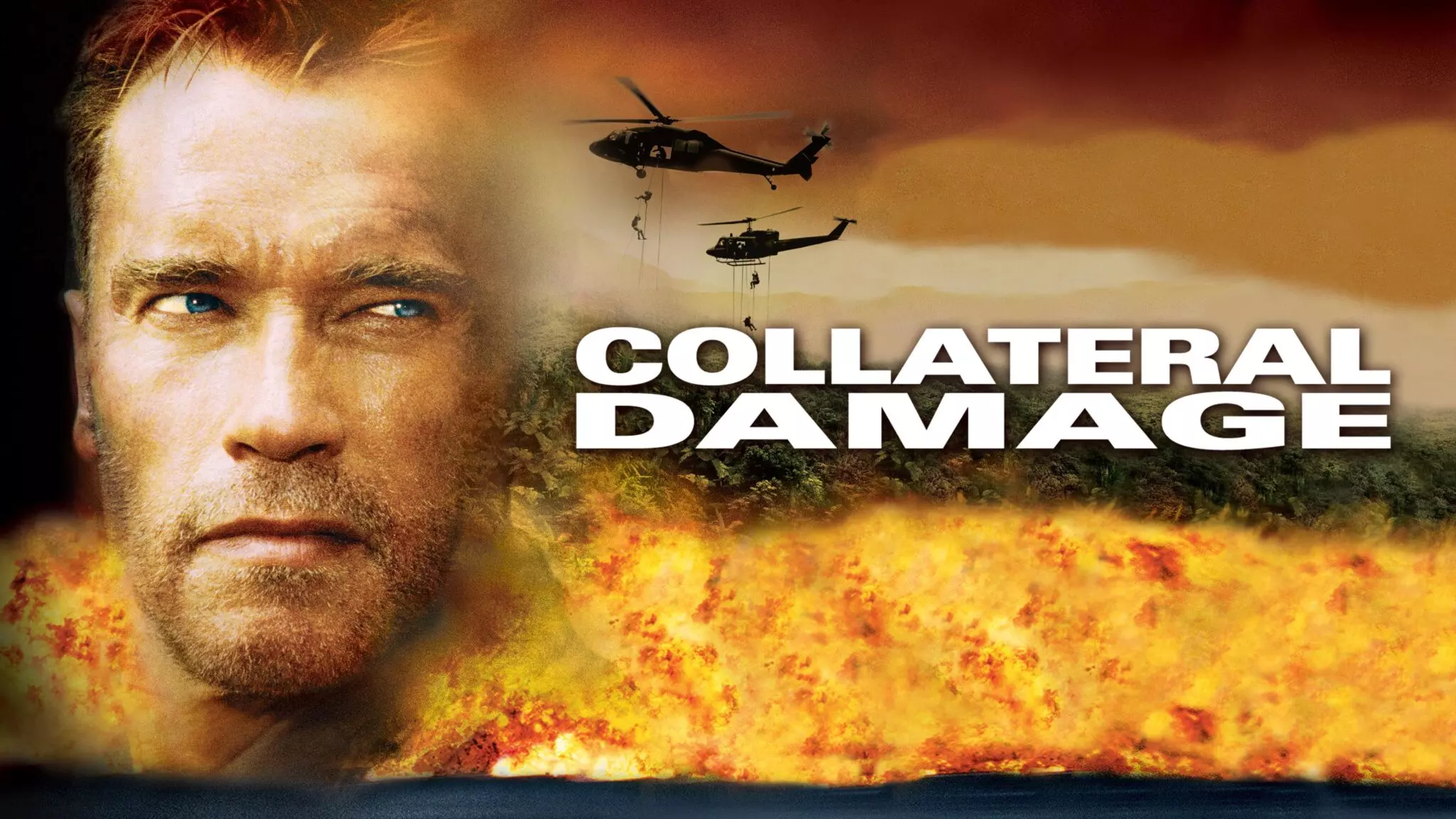
In the gritty action drama Collateral Damage (released in theaters on Feb. 8, 2002), Gordon Brewer (Arnold Schwarzenegger) is a resilient Los Angeles firefighter whose life is shattered in an instant. While waiting to meet his wife and young son near the Colombian consulate, he witnesses a devastating bomb blast that kills his family.
The target was a group of Colombian officials, and the attack is claimed by Claudio “El Lobo” Perrini (Cliff Curtis), a ruthless terrorist known as the Wolf.
When the American government’s investigation stalls due to political red tape and the cautious maneuvering of CIA agent Peter Brandt (Elias Koteas), Brewer realizes that official channels will never bring the terrorist to justice.
Driven by grief and a singular sense of purpose, he decides to take matters into his own hands, traveling to the dangerous jungles of Colombia to hunt down his family’s killer.
Once in the war-torn territory, Brewer is a fish out of water, relying on his wits and firefighting tools rather than military training. He navigates a treacherous landscape filled with guerilla factions and corrupt officials.
Along his journey, he encounters a variety of characters who both hinder and help his mission, including the eccentric, cocaine-processing plant manager Felix Ramirez (John Leguizamo) and a paranoid Canadian mechanic named Sean Armstrong (John Turturro).
The plot thickens when Brewer meets Selena (Francesca Neri), a woman who appears to be an innocent victim of the conflict but holds deep ties to El Lobo.
Directed by Andrew Davis, the film avoids the “invincible hero” tropes of typical 80s action, presenting Brewer as a vulnerable man pushed to the brink as the trail of vengeance leads him back to Washington D.C. for a high-stakes finale.
Miguel Sandoval, Lindsay Frost, Jane Lynch, Jsu Garcia, Raymond Cruz, Michael Milhoan, and Nicholas Pryor round out the cast.

Collateral Damage (Photo/Warner Bros.)
Reception for Collateral Damage
Collateral Damage grossed $15.2 million on its opening weekend, finishing No. 1 at the box office.
The film would gross $78.4 million worldwide.
Roger Ebert gave Collateral Damage three out of four stars in his review.
Legacy
Collateral Damage‘s legacy is inextricably linked to the historical moment of its release. Originally scheduled for autumn 2001, its premiere was delayed significantly following the September 11 attacks due to its sensitive plot involving terrorism on American soil.
This context fundamentally altered how audiences perceived the film, shifting it from a standard action vehicle into a somber reflection on the complexities of modern warfare and the human cost of political conflict.
It is remembered as one of Schwarzenegger’s more grounded performances, marking a transition toward more mature, vulnerable roles.
The film remains a notable entry in Davis’s filmography for its realistic production design and its attempt to humanize the “collateral damage” often dismissed in geopolitical headlines.