









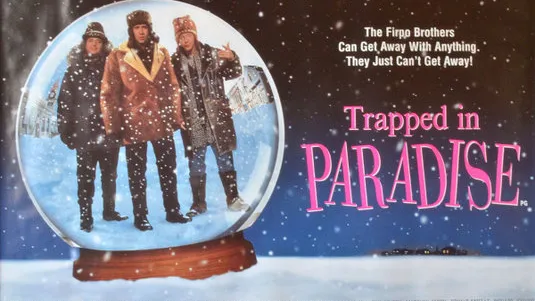
Trapped in Paradise, released in theaters on December 2, 1994, stands out in the mid-90s blizzard of high-concept holiday comedies as a strange, lurching hybrid: part caper movie, part Capra riff, and part showcase for three very different comic energies colliding in the snow.
Set in the impossibly wholesome town of Paradise, Pennsylvania, the film leans on Nicolas Cage’s exasperated straight man while Dana Carvey and Jon Lovitz spin in their own cartoon orbits, creating a tone that veers wildly between sentimental and unhinged. The result is messy, often repetitive, but intermittently amusing in a way that has helped it hang on as a minor cult Christmas curiosity rather than a forgotten flop.
Bill Firpo (Cage) is a weary New York restaurant manager trying to keep his newly paroled brothers, kleptomaniac Alvin (Carvey) and compulsive schemer Dave (Lovitz), on the right side of the law when they talk him into a “simple” errand in Paradise, Pennsylvania.
Once there, they discover the town’s bank is laughably underprotected, and Bill allows himself to be dragged into a Christmas Eve heist that goes surprisingly smoothly—at least until their getaway car skids off an icy bridge, stranding them in the very town they just robbed.
With the roads closed, the brothers find unexpected shelter among the warm-hearted locals, including the family of the bank president and a sympathetic woman named Sarah (Mädchen Amick), whose kindness intensifies Bill’s guilt.
As a furious criminal from their past arrives to claim the loot and takes hostages, the Firpos are forced into a chaotic series of escapes, double-crosses, and improvised rescues that push them toward a grudging moral awakening and a desperate attempt to return the money before they are caught.
The movie’s biggest asset is its off-kilter ensemble led by Cage, who plays Bill with a fraying patience that periodically explodes into the sort of manic line readings that made his 90s work so distinctive, giving the character more volatility than the screenplay really earns.
Carvey leans into Alvin’s kleptomania with a twitchy, almost childlike weirdness, while Lovitz’s Dave hustles every scene with motor-mouthed rationalizations, the two together turning many dialogue exchanges into overlapping bits of sketch comedy.
John Ashton and Donald Moffat embody the town’s flinty decency, Richard Jenkins has fun as a stiff-backed FBI man baffled by everyone’s niceness, and familiar faces like Frank Pesce and Richard B. Shull help fill out a world that feels like a live‑action cartoon of small‑town America.
The clash between broad slapstick car crashes and hostage showdowns on one side and cozy fireside warmth on the other often feels ungainly, but it does give the film a peculiar identity that’s hard to confuse with slicker holiday fare.
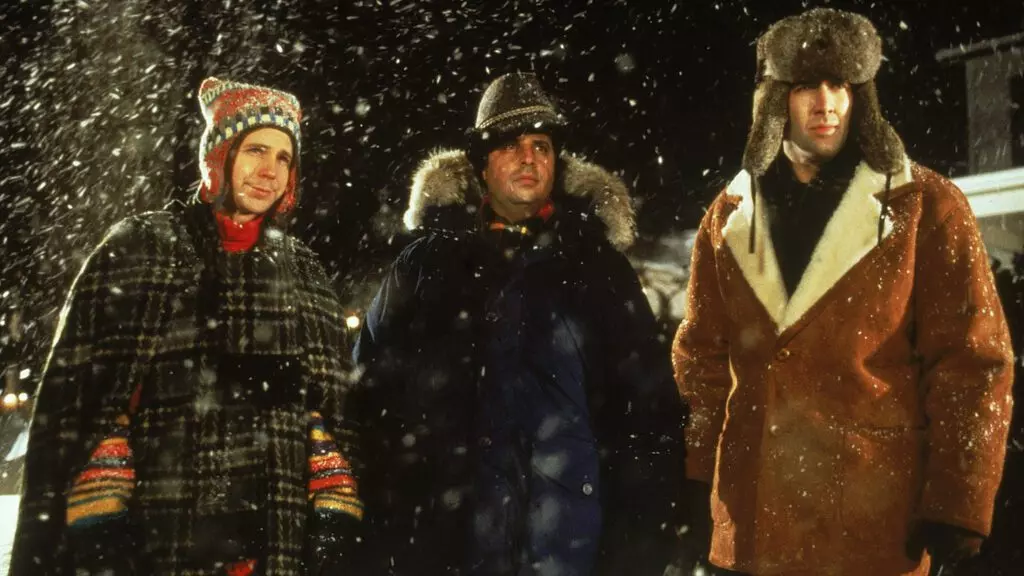
Dana Carvey, Jon Lovitz and Nicolas Cage in Trapped in Paradise (Photo/20th Century Fox)
Reception for Trapped in Paradise
Trapped in Paradise grossed $2.7 million on its opening weekend, finishing seventh at the box office.
The film would gross $6 million in its theatrical run.
Legacy
On release, Trapped in Paradise was widely panned for its overlong running time, repetitive gags, and tonal whiplash, and it underperformed at the box office compared with other 1994 holiday offerings.
Yet over time it has found a niche audience among Cage completists and viewers who enjoy Christmas movies precisely because they are chaotic, uneven, and stuffed with character actors giving more than the material probably deserves.
Seen today, the film plays like a transitional artifact: an early example of Cage’s emerging “gonzo leading man” persona, a relic of studio faith in high-concept seasonal comedies, and a reminder of how heavily 90s Hollywood leaned on SNL alumni to juice mid-budget projects.
It may never graduate to canonical holiday status, but as an offbeat, snowbound time capsule of three clashing comic styles stuck together in the same frame, Trapped in Paradise offers just enough awkward charm to justify a late‑night December revisit.